

Cosmetic Bonding vs. Veneers: Which One Is Right For You? (Honest Pros & Cons from a Chicago Cosmetic Dentist)
By Dr. Brittany Dickinson | Chicago Aesthetic Dentistry, Lakeview
The question I get more than almost any other in my cosmetic consults:
"Should I do bonding, or should I do veneers?"
I always answer it the same way — by gently telling the patient it's the wrong question.
The right question isn't bonding vs. veneers. The right question is: what kind of change are you actually trying to make to your smile? Because composite bonding and porcelain veneers are not two versions of the same procedure. They're two different tools built for two different jobs. One isn't better than the other in some absolute sense. They're better at different things — and when you match the tool to the job, you get a result that looks beautiful and lasts the way it's supposed to. When you mismatch them, you get a result you'll be unhappy with within a few years.
Here's the honest breakdown of how I think about it, and how I help patients decide.
What Each One Actually Is
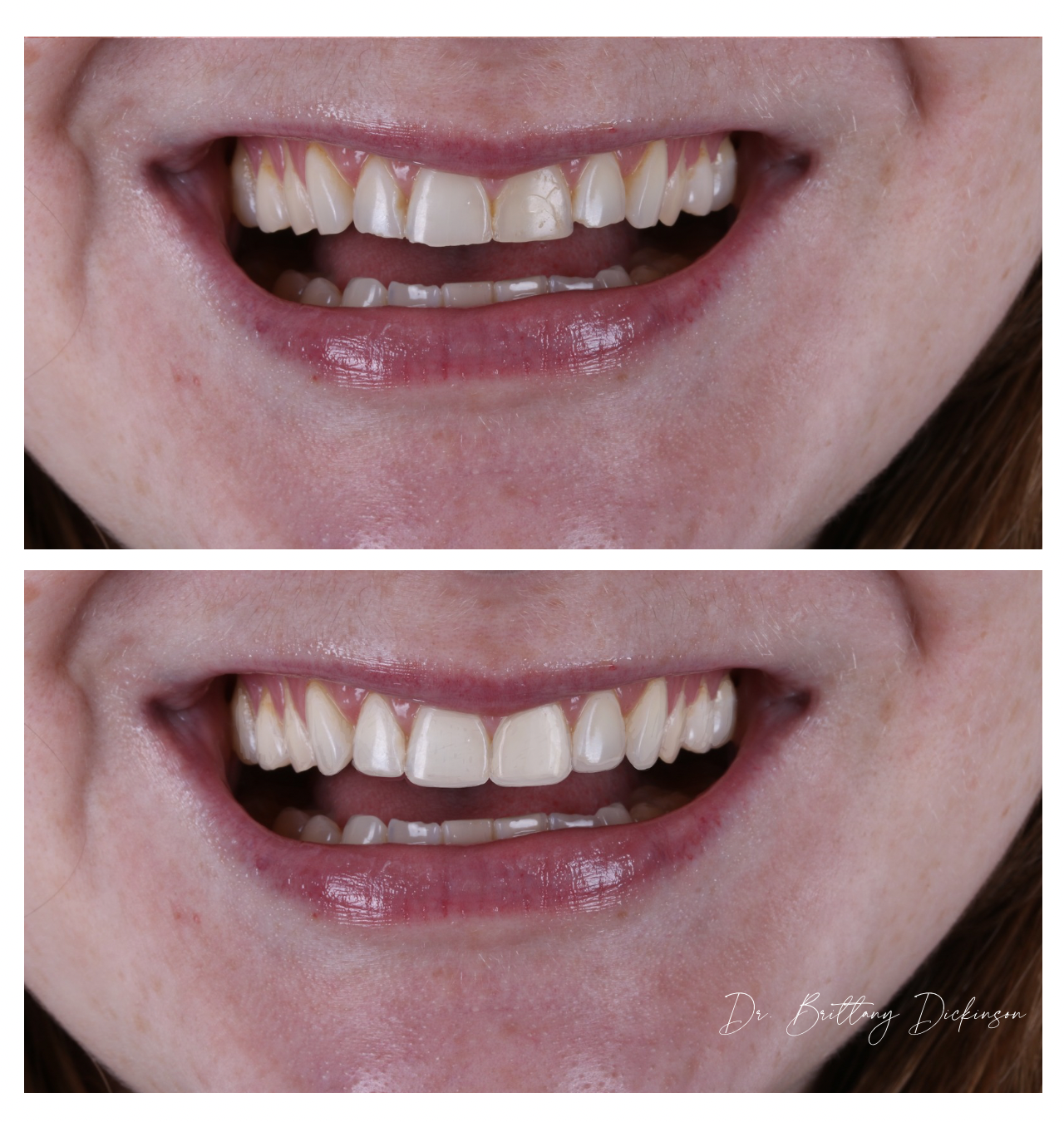
Composite bonding is a tooth-colored resin (essentially a sophisticated dental filling material) that I hand-shape directly onto your tooth in the chair. I sculpt it, light-cure it, refine it, and polish it — all in one visit. There's usually no anesthesia required, no lab involved, and very little (often none) of your natural tooth has to be removed. The result is layered on top of or alongside your existing tooth structure.
Porcelain veneers are thin, custom-fabricated shells of dental porcelain that are bonded permanently to the front surface of your teeth. They're designed in a wax-up or digital mockup, fabricated by a dental laboratory, and bonded onto teeth that have usually been very lightly prepared. The result is essentially a new outer layer for the tooth, engineered by a master ceramist.
That's the structural difference. The functional difference is what actually matters for your decision.
Composite Bonding — The Honest Pros and Cons
The case for bonding:
Conservative. Often requires no tooth removal at all, or only minor surface roughening. Your natural tooth stays mostly intact underneath.
Reversible (in many cases). Because we're not prepping the tooth, bonding can often be removed or redone after if you want to change the result.
One visit. Most bonding cases — even multi-tooth cosmetic bonding — are start-to-finish in a single appointment.
Lower cost. Bonding is typically the lower-investment cosmetic option per tooth.
Excellent for small, localized changes. A chipped corner. A small gap. A slightly worn edge. A single discolored tooth. Bonding shines here.
The honest tradeoffs:
Stains over time. Composite material is more porous than porcelain. It absorbs coffee, red wine, and pigment over the years. All bonded teeth need refreshing every couple years to keep them looking right.
Chips and wears. Composite is durable, but not as durable as porcelain. Patients who clench, grind, or bite into ice/pens/nails will wear and chip bonding faster.
Lifespan: 2-3 years on average in my experience, depending on location in the mouth, bite forces, and habits. Some last longer; some need touch-ups sooner.
Limited for large redesigns. Bonding can mimic individual teeth beautifully, but recreating an entire smile out of composite is hard to make look natural — especially in terms of translucency, light reflection, and longevity.
Porcelain Veneers — The Honest Pros and Cons
The case for veneers:
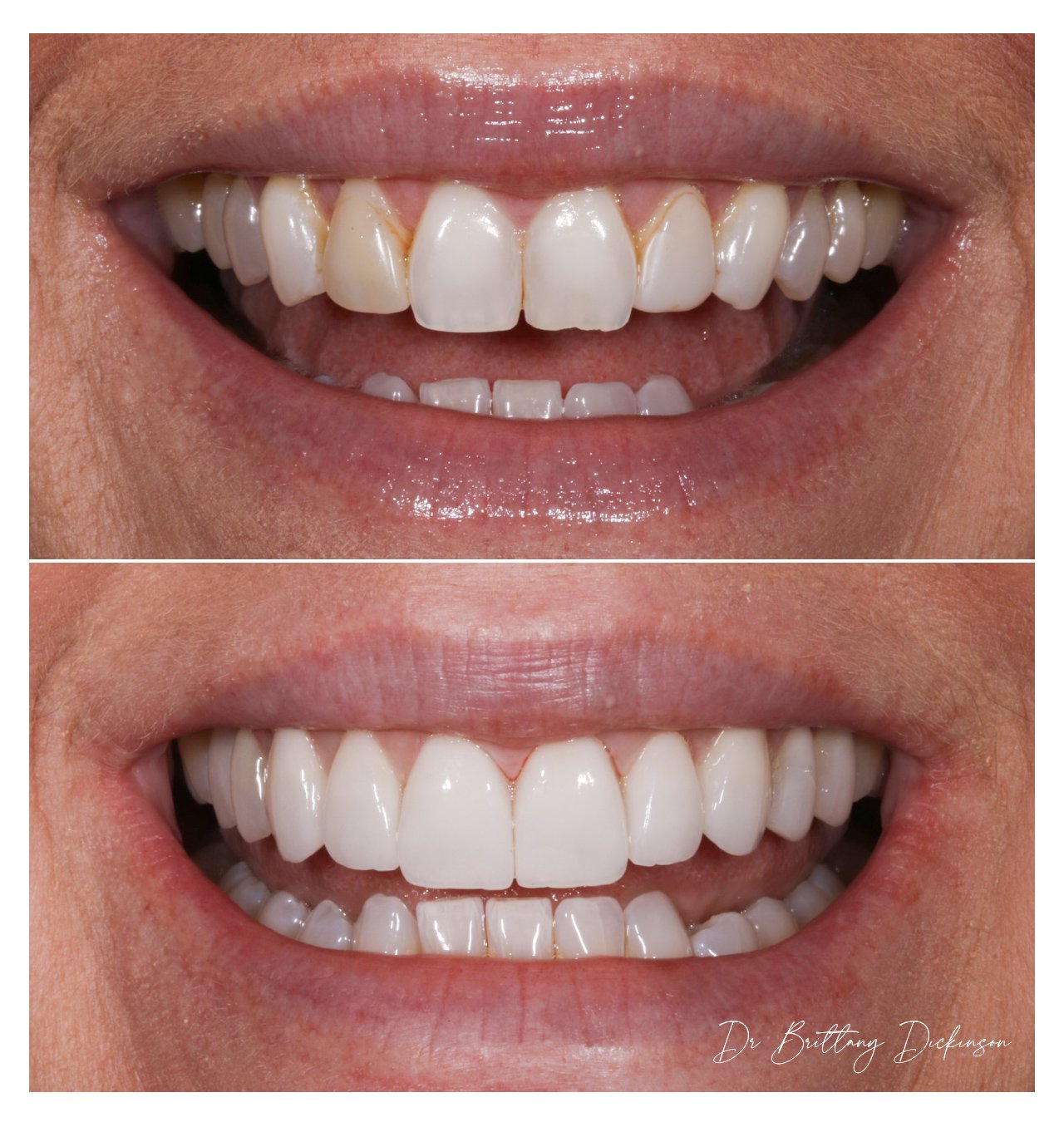
Durability. Porcelain is the most stable, stain-resistant cosmetic material we use in dentistry. Veneers don't darken with coffee. They don't pick up red-wine stains. They don't dull the way composite does.
Lifespan: 15–20 years with good home care. I've seen veneers from skilled ceramists last decades.
Light optics. A well-made porcelain veneer reflects and transmits light the way a natural tooth does. The result reads as a real tooth, not a covered tooth. This is something composite can approximate but never fully match.
Comprehensive redesign. When we're changing tooth shape, length, proportion, alignment, color, and the entire visual identity of the smile, veneers are the right tool. The lab process gives us the precision to design every tooth in relation to every other tooth and to your face.
The Facially Driven Smile Design framework lives here. When I'm designing a smile in relation to your face shape, jawline, and upper lip drape, I need the precision of a porcelain workflow to execute the design.
The honest tradeoffs:
Permanent. Most veneer cases require some preparation of the natural tooth — usually very minimal, but real. Once veneered, the tooth typically needs to remain veneered. The decision is durable.
Higher investment. Veneers are a meaningful step up in cost from bonding. I price them transparently and all-in, and I quote the full case (including any retainers or night guards) up front.
Two or more visits. Veneers require a planning/prep appointment, lab fabrication time, and a bonding appointment — sometimes with a try-in stage in between.
The wrong dentist can make them look fake. This is real. Veneers don't look fake because they're veneers — they look fake when they're designed improperly. (I wrote about this at length in Will My Veneers Look Fake?)
So How Do You Actually Decide?
When a patient sits in my chair asking "bonding or veneers?", I walk through a short rubric with them. Here it is.
You're probably a bonding case if:
You're fixing one or two small things — a chipped corner, a small gap, a worn edge, a single dark tooth.
You want a conservative, reversible approach. You're not ready for a permanent change.
You're early in your cosmetic journey and want to test how comfortable you are with small changes before committing to anything bigger.
Your budget is the limiting factor right now, and the alternative is doing nothing. A great bonding result now is better than waiting years for veneers you can't yet invest in.
The change you want is shape-only, not color-and-shape. (Bonding is harder to use to dramatically change the color of multiple teeth at once. It's beautiful for shape and contour.)
You're probably a veneers case if:
You're redesigning the whole front of your smile — multiple teeth, with multiple things changing (shape, length, color, proportion, alignment).
You want durability and stain resistance as a defining feature. You drink coffee. You drink red wine. You don't want to think about your smile for the next 15+ years.
You want light optics that read as completely natural — translucency, edge characterization, subtle color variation tooth-to-tooth. That's a porcelain conversation.
You're correcting worn, short, or asymmetrical teeth as a comprehensive case. Bonding can do small worn-tooth repairs; veneers can rebuild a worn-down smile properly.
You're combining cosmetic work with gum contouring or other smile-design changes. The precision of a porcelain workflow lets us design every element together.
You want a result engineered by a master ceramist in a lab — not hand-sculpted at the chair.
You're a "let's talk more" case if:
You're somewhere in between. Maybe you want a noticeable improvement but you're not ready for veneers, and bonding feels too small. There are real intermediate options worth discussing — including no-prep veneers, which preserve tooth structure while giving you the durability of porcelain.
How I Personally Decide
Here's the philosophy underneath all of this.
I design every cosmetic case in my practice using Facially Driven Smile Design — a framework that positions teeth in relation to your face shape, your jawline, and the way your upper lip drapes over your teeth when you talk, smile, and rest. The teeth and gums sit inside a frame — your face — and they only look right when they're balanced to that frame.
That philosophy applies whether I'm doing bonding, veneers, gum contouring, or all three together.
What changes is the scope of the redesign. If I'm fixing one tooth that doesn't fit the frame, bonding is often the right tool — minimal, conservative, in-and-out. If I'm redesigning the whole frame — multiple teeth, gum line, midline, proportion to face — veneers (often combined with gum contouring) give me the precision and durability the redesign requires.
The wrong move, in my opinion, is to default to veneers for everything because they're the more "premium" option. A skilled cosmetic dentist should be just as comfortable doing beautiful, conservative bonding as they are doing a full veneer case. If a dentist is only ever offering you the bigger procedure, ask why.
It's also why I do my own honest filter at the consult: I'd rather talk a patient out of veneers and into a thoughtful bonding plan than upsell them into something they don't need. The patients who refer friends to me are the ones whose smiles look beautiful and whose treatment plans matched what they actually came in for.
What Each One Costs in My Practice
I price both bonding and veneers transparently and all-in — no surprise add-ons.
Composite bonding ranges depending on how many teeth and how much sculpting is required. Single-tooth touch-ups start in the lower hundreds; multi-tooth cosmetic bonding cases scale up from there. I quote the exact fee at your consult after I've seen what we're actually working with.
Porcelain veneers are priced per case, with the case quoted all-in including any retainer or night guard at the end. A full upper smile (typically 10-12 veneers) is the most common case in my practice, and I quote the full case transparently up front.
A note on insurance: For most patients, both bonding and veneers are considered cosmetic and not covered — but we'll be straightforward about what to expect before treatment begins.
We also offer low- to no-interest financing through CareCredit® and accept all major credit cards.
The Short Version
If you're fixing one or two small things — bonding. If you're redesigning a whole smile — veneers. If you're somewhere in between — let's talk.
And if a cosmetic dentist is only ever offering you the bigger option, that's worth a second opinion. The best cosmetic dentistry is the kind that's matched to the patient, not the other way around.
If you'd like to figure out which one is the right tool for your smile, book a smile design consultation and we'll walk through it together — honestly.
Dr. Brittany Dickinson is a cosmetic dentist in Lakeview, Chicago, and a member of the American Academy of Cosmetic Dentistry (AACD). She designs every smile using Facially Driven Smile Design — a philosophy that positions teeth and gums in relation to face shape, jawline, and upper lip drape rather than to a textbook ideal. Learn more about composite bonding, porcelain veneers, or her overall approach to cosmetic dentistry.