

No-Prep Veneers in Chicago: A Real Before & After Case Study
Why This Case Mattered
When this patient walked into my Lakeview office, she didn’t have a “bad” smile. She had a beautiful smile in every way that mattered — straight teeth, healthy gums, meticulous oral hygiene. What she had was a problem her body had been quietly compensating for since childhood.
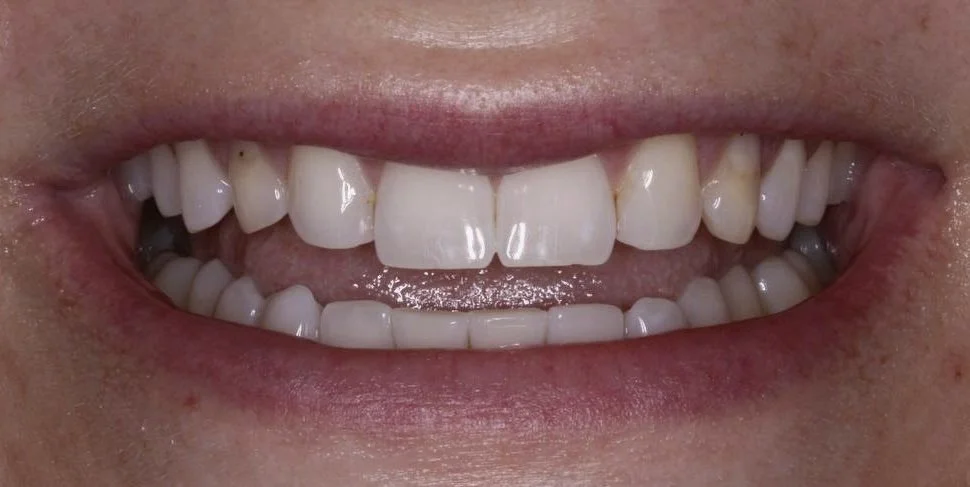
She was born missing some of her adult teeth — a condition called congenitally missing teeth, more common than people realize. Her baby teeth had been kept in place for decades and built up with dental bonding to make them look like adult teeth. For years, that bonding worked. But bonding doesn’t last forever. By the time she came to me, the old composite was breaking down at the edges, staining at the seams, and chipping every few months.
She was tired of the repair cycle. She wanted something permanent, something natural-looking, and something that didn’t require destroying the healthy teeth she’d worked so hard to take care of.
No-prep veneers were the answer — and this is exactly the kind of case they were designed for.
What “No-Prep” Actually Means
In a traditional veneer case, a cosmetic dentist removes a thin layer of enamel — usually 0.3 to 0.7 millimeters — to make room for the porcelain. It’s conservative, but it’s not reversible. Once enamel is gone, it’s gone.
No-prep veneers are different. They are ultra-thin shells — thinner than a contact lens in some areas — that bond to the outside of your natural teeth without removing any enamel at all. That changes the conversation for a patient like this one. Because her natural teeth were healthy and small (baby teeth never grow to full adult size), we weren’t trying to reduce her teeth to make room for veneers. We were trying to add to them — to make small teeth look proportional to her face, fuller in her smile, and brighter overall.
That’s a job no-prep veneers do better than any other restoration.
Why This Case Was an Ideal No-Prep Candidate
Not every patient is a candidate for no-prep veneers. They work best when:
The natural teeth are smaller than the desired final result (so we’re adding volume, not subtracting)
The teeth are already well-aligned (no-prep can’t disguise significant crowding or rotation)
The patient has healthy enamel and gums (no-prep is additive, not corrective)
The patient wants a reversible, conservative option with no permanent enamel changes
This patient checked every box. Her alignment was beautiful from years of careful care. Her gums were healthy. Her teeth were just small — and the old bonding had run its course.
The Material: A Hybrid You Won’t See at Most Practices
The veneers I placed are made from a porcelain-composite hybrid material — and this is one of the most underrated reasons I chose them for her case.
Here’s what makes the hybrid different from traditional porcelain:
1. Fully adjustable, chair-side, after they’re placed. Pure porcelain veneers are essentially permanent in shape once they’re fired in the lab. The hybrid can be reshaped, polished, and refined after bonding — so if she wants to soften an edge, round out a corner, or adjust a contour months from now, we can do it in a single visit without remaking the veneer.
2. Polishable indefinitely. The composite component takes a high polish the way natural enamel does. Over time, if anything dulls or picks up surface stain, we can restore the shine in minutes — not months.
3. Ultra-thin means plaque-friendly margins. Because the veneer edges are so thin and bond directly to enamel without a ledge, there is no shelf or rough seam at the gumline for plaque to catch on. This is one of the biggest hidden advantages of no-prep cases done well. Conventional veneers can create a tiny step at the margin; no-prep bonded onto healthy enamel sits flush.
For a patient who takes excellent care of her teeth, this matters. We weren’t going to undo her hygiene work by giving her a restoration that fought back.
The Result
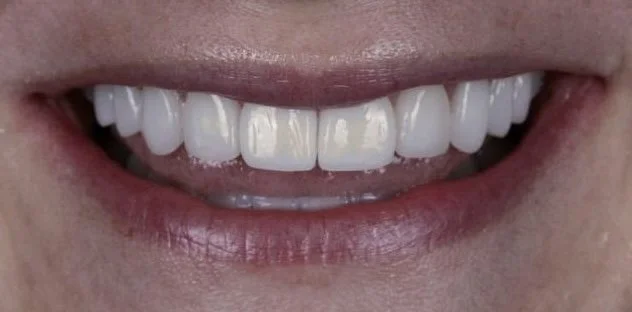
You can see the comparison above. What changed:
Size and proportion: Small baby teeth now look like full adult teeth, properly proportioned
to her face shape and lip line.
Color: Uniform, bright, and warm — not the cool fluorescent white that gives away “obvious
veneers.”
Incisal edges: Smooth, even smile arc replaces the stepped, worn line of the old bonding.
Symmetry: Centrals, laterals, and canines now read as a balanced set.
What didn’t change:
Her healthy underlying teeth (none of which had any enamel removed)
Her bite
Her ability to reverse the work if she ever wanted to (she won’t — but she could)
When she saw the result, she hugged me. She told me they felt brighter and fuller, but still looked like her.
That’s the entire point of Facially Driven Smile Design — the philosophy that runs through every cosmetic case in my practice. We design smiles in relationship to the patient’s face shape, jawline, and the way the upper lip drapes over the teeth. Then we position teeth (or in this case, build out their proportions) to support the lip and look natural with the specific person sitting in
my chair. Not a generic textbook ideal. Not what an off-the-shelf shade guide says is “right.” What looks right on her.
Is a No-Prep Case Right for You?
If you’re considering veneers and any of the following sounds like you, no-prep may be the better option to discuss at your consultation:
You have smaller teeth you want to make larger or more proportional
You have old bonding that keeps breaking down
You were born missing teeth or have retained baby teeth into adulthood
You want a fully reversible cosmetic option
You have healthy enamel you don’t want to give up
You want a restoration that’s adjustable and polishable over time
If any of those describe you, the next step is a Smile Design Consultation — the conversation- first appointment we use to figure out what’s right for your specific case. No instruments unless you want them. No pressure. No surprise plan at the end.
Pricing Note
This case falls into the cosmetic veneer pricing range published on our veneers page.
Related reading
- Do Veneers Ruin Your Teeth? An Honest Answer — the deeper answer to "what really happens to enamel," for anyone curious about the traditional prep approach.
- Will My Veneers Look Fake? — how Facially Driven Smile Design avoids the "chiclet" look in cosmetic cases.
- How to Get Natural-Looking Veneers in Chicago (Without the Veneer Look) — the design principles behind what makes a veneer look like your own teeth.