

Invisalign in Lincoln Park: What Busy Professionals Should Know Before Starting
You've been thinking about Invisalign for two years.
Maybe longer. You had braces in middle school, your teeth shifted back in your twenties, and now — somewhere in your early-to-mid thirties, deep in a career that has you on Zoom from 8 a.m. to 6 p.m. and at Daisies or Avec a few nights a week — you've decided your smile isn't quite what you want it to be.
Every time you almost pull the trigger, the same questions stop you. Can I really wear these during meetings? What about dinners? What does the timeline actually look like for someone with my schedule? You Google it, get a sea of generic dental-practice blog posts written for everyone and no one, and decide to revisit it next quarter.
I see this pattern in my Lincoln Park patients constantly. So I want to give you the answers — the honest ones — from someone who's planned over 200 adult Invisalign cases for professionals in this neighborhood. Here's what the workweek actually looks like in aligners.

Can I Wear Aligners During Meetings? (Yes — and No One Notices)
This is the question every busy professional asks first, and it's the one with the most reassuring answer.
You wear Invisalign aligners 20 to 22 hours a day. They go in at the start of your day, they come out at meals, and they go back in within an hour. That's it. The rest of your day — the back-to-back meetings, the calls, the deal lunches, the after-work presentations — you're wearing them.
Are they visible on video calls? Almost never. Today's Invisalign aligners are made of TruGen plastic, which is genuinely thin and clear. On a Zoom call, your camera is sitting 18 to 24 inches from your face, and at that distance the aligners are virtually undetectable. The patients I treat who are on camera for a living — brand strategists, real estate agents, in-house counsel, founders — tell me their colleagues didn't notice until they mentioned it.
The one caveat: there's a slight lisp in the first week. You'll hear it more than anyone else does. It almost always disappears within 7 to 10 days as your tongue adapts, and most patients adjust well before their first big presentation. If you have something major coming up — a panel, a wedding toast, a board meeting where you're presenting — we plan your start date around it.
If you want the full clinical timeline of what each appointment looks like, our Lincoln Park Invisalign page breaks down every stage from consult to retainer.
What About Dinners, Dates, and Cocktails?
This is the question I get from almost every professional in their 30s — especially the ones who, between work dinners and dating in Chicago, spend half their week eating out.
The reality is straightforward. Your aligners come out for every meal. They go back in within 60 minutes. You brush, or at least rinse, before reinserting. That's the protocol.
Where most busy professionals slip — and where a 9-month case quietly becomes a 14-month case — is the night out. Dinner at Roister, drinks at Pacific Standard Time, a long table at Daisies. The aligners come out for the food, and then they just… stay out. Two hours becomes four. Four becomes the rest of the night. Multiplied across a few weeks, that's a real delay.
The fix is simple but takes intention: keep a travel toothbrush and an aligner case in your bag. Most of my Lincoln Park patients build this habit in the first month and never go back. After a couple of dinners where you've quietly stepped away to the bathroom for two minutes to brush and reinsert, it becomes second nature.
A quick rundown on what you can and can't have with aligners in:
Coffee with aligners in: Only if it's black. Cream, sugar, or syrup means remove, drink, brush, reinsert.
Wine, cocktails, beer: Aligners out. Even clear cocktails will stain the trays and accelerate gum-line bacteria.
Water: Always fine.
Sparkling water: Fine, but be aware of acidity — long-term, plain water is better for your enamel.
None of this is hard once you have a system. It's just unfamiliar at first.
How Long Will This Actually Take?
There are two real timelines I work with for adult Invisalign cases, and which one you fall into depends entirely on what your teeth are doing.
Invisalign Express ($5,500 all-in)
5 to 7 sets of aligners, 3 to 6 months of treatment. This is the case I see most often in Lincoln Park professionals: minor crowding, small spacing issues, or post-orthodontic relapse from teenage braces that never quite held. If your teeth are mostly where they should be and you want a refinement rather than a transformation, this is usually the right tier.
Invisalign Comprehensive ($7,000 all-in)
9 to 15 months of treatment, includes refinements at no additional cost. This is the right tier when there's real crowding, bite correction needed, or when the entire smile arch needs reshaping. It's longer, but the result is meaningfully more transformative.
Both prices include your final retainer. That's an important detail — most cosmetic dentists and orthodontists quote Invisalign without retainers and then surprise you with a $600 retainer charge at the end of treatment. We don't do that. The number I quote you on day one is the number you pay. If you're combining Invisalign with veneers for a fuller smile makeover, that combined package starts at $16,000 — also all-in.
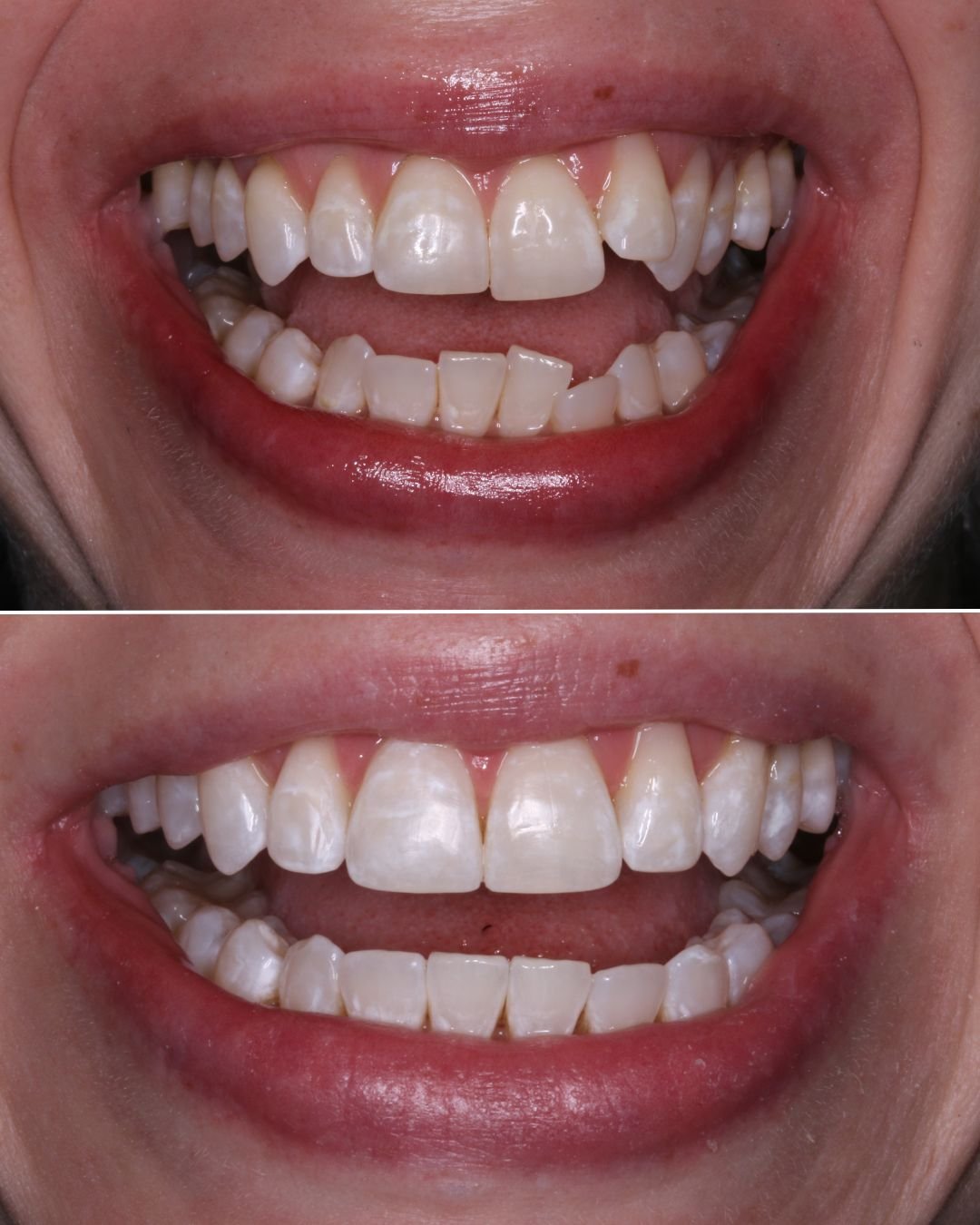
One thing worth knowing about timelines: they're not linear. You'll see the visual change start around month two or three, but the most dramatic shifts happen in the middle third of treatment. The "before" disappears faster than the "after" arrives, and that gap can feel strange for a few weeks. It's normal. Trust the plan.
For the full pricing breakdown including combined Invisalign + veneer cases, see our Invisalign hub page.
Why Facially Driven Smile Design Matters More for Professionals
Here's where I'll get a little opinionated, because this is the thing that genuinely differentiates how I treat Invisalign — and it matters more for professionals than almost anyone.
Standard Invisalign treatment positions your teeth according to a textbook ideal. The software runs an algorithm, generates a treatment plan, and your aligners move your teeth to a generically "correct" position. For most dentists, that's the end of the planning conversation.
I override that. Every Invisalign case I do is designed using what I call Facially Driven Smile Design — I position your teeth in relation to your face shape, your jawline, and specifically how your upper lip drapes when you speak and smile. The teeth don't exist in isolation. They have to look right against the rest of your face.
Why does this matter more for professionals? Because you're on camera. You're across negotiation tables. You're speaking on stages, in panels, in client meetings, on video. Your smile is doing work, and it has to look right on you — not generic-right.
The post-Invisalign assessment most of my Lincoln Park patients give me, six months after their case finishes, is this: they didn't know what the difference would look like until they saw the after. And then it was obvious. The smile looked like theirs — the version of theirs they'd been hoping for — not a stock-photo smile that happened to be in their mouth.
This is what 2 years of Invisalign mentorship training and 200+ adult cases buys you. Not faster aligners. Better positioning decisions on the front end, made by a human who understands what a smile is supposed to do on a real face.
Some patients combine Invisalign with veneers for a final layer of refinement. Here's how that decision works.
How This Actually Fits a Lincoln Park Workweek
Logistics matter, so let me be specific about ours.
Office location: We're on the corner of Lincoln, Paulina, and Roscoe in Lakeview — a 7-minute drive north from most of Lincoln Park, or one stop on the Brown Line from the Paulina station. If you're in Old Town or DePaul, it's even closer.
Appointment cadence: You'll see me every 6 to 8 weeks during active treatment. Each visit is 20 to 30 minutes. We're open Monday through Thursday, and most of my Lincoln Park patients schedule first thing in the morning before work, on their lunch hour, or as the last appointment of the day before they head to their workout or out for dinner. We work around your calendar, not the other way around.
Insurance reality: We're fee-for-service and out-of-network. That means you pay directly for treatment, and we submit the paperwork on your behalf so you can be reimbursed by your insurance. Most patients with PPO plans get $1,000 to $1,500 back. We handle the submission as a courtesy.
That's the practical picture. Twenty-minute appointments every six to eight weeks, scheduled around your real life, with a straightforward financial conversation at the consultation so there are no surprises later.
The Bottom Line
If you've been stalling on Invisalign for a year or two, it's probably not because you're not ready. It's because nobody has told you the truth about what the workweek actually looks like in aligners.
For most of my Lincoln Park patients, it's far less disruptive than they expected, and the case finishes faster than they planned. The aligners disappear into the day. The dinner protocol becomes muscle memory. The "before" fades faster than they expected, and the smile that emerges actually looks like theirs.
The hardest part is just starting.
If you want to know whether you're a candidate, what your timeline would actually be, and what the all-in number would look like for your specific case, the Smile Design Consultation is the right first step. It's 60 minutes. It includes a full facial analysis. And at the end, you'll have real answers to every question above — for your face, your schedule, and your smile.
**Book a Smile Design Consultation**
Dr. Brittany Dickinson is a cosmetic dentist and AACD member practicing in Lakeview, Chicago. She has completed Invisalign's 2-year advanced provider mentorship and has planned over 200 adult Invisalign cases — many for Lincoln Park professionals.