

Will My Veneers Look Fake? How to Avoid the "Chiclet" Smile (A Chicago Cosmetic Dentist's Honest Answer)
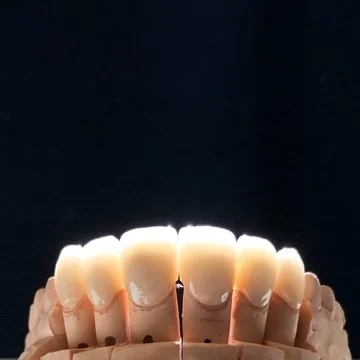
Custom porcelain veneers by Dr. Brittany Dickinson, Chicago Aesthetic Dentistry — natural-looking, layered porcelain craftsmanship.
It's the first question almost every cosmetic patient asks me. Sometimes it's the only question.
"I want to do this — but I don't want anyone to be able to tell."
I understand the fear. We've all seen the smile that walks into a room before its owner does — the row of identical white rectangles, the teeth that don't quite move with the face, the smile that announces itself. Once you've seen it, you can't unsee it. And if you've been quietly thinking about veneers for years, the fear of ending up with that smile is often the single thing holding you back.
So I want to answer this honestly, the way I answer it at a consultation in my Lakeview practice.
Veneers don't look fake because they're veneers. They look fake because they were designed wrong. And the design mistakes that produce the "chiclet" smile are specific, identifiable, and entirely avoidable.
Here's what actually goes wrong — and the philosophy I use to make sure none of it happens to my patients.
What actually makes veneers look fake
When I look at a smile that reads as obvious, it's almost always one (or a combination) of the following six design failures:
1. Too white
This is the single biggest tell. There is a shade of white that does not exist in nature. When teeth are brighter than the whites of the eyes — brighter than any tooth a healthy person has ever had — the brain registers it immediately as artificial, even if it can't articulate why.
Natural teeth have warmth. They pick up subtle yellow, gray, and even a quiet hint of translucent blue at the edges. A well-designed veneer is bright, yes — usually a stop or two whiter than the patient's starting shade — but it stays within the range of real. We choose a shade that flatters the patient's skin tone and the whites of their eyes, not the brightest tab on the guide.
2. Too long, or wrong length for the face
The length of your front teeth has to be set against your face, not a textbook. Specifically, against where your upper lip lands when you smile, how much tooth shows when you talk, and the proportions of your lower face.
Veneers that are too long are the second biggest tell. They make a smile look horsey, toothy, or stretched. Veneers that are too short — less common — make a smile look aged. Both happen when the dentist designs the case in isolation from the face it lives in.
3. Wrong shape for the face
This is more subtle and more important than most patients realize. Square, soft-square, rounded, and oval tooth shapes each suit different faces. A delicate, oval-faced patient with a soft jawline shouldn't be given square, masculine front teeth. A patient with strong features and a defined jaw will look strange with overly rounded, "feminine" teeth.
When every veneer case at a practice gets the same shape — the dentist's house shape, the lab's default — the work starts to look like a uniform. You can spot it across a room.
4. Opaque, with no translucency
Real teeth aren't solid. They have layers. The inner part of the tooth (dentin) is warmer and more opaque; the outer edge (enamel) is translucent and picks up light. When you look at a natural front tooth in good lighting, you can see the edge has a soft, almost glassy quality that lets a hint of light through.
Cheap or rushed veneers — especially monolithic ones milled out of a single block of porcelain — can come out flat and opaque, with no translucency at the edge. The tooth reads as a sticker rather than a tooth. Layered porcelain veneers, built up by a master ceramist with translucent enamel material at the incisal edge, look like actual teeth. It's a difference you don't have to be a dentist to see, once you know to look.
5. Every tooth identical to the one next to it
Real front teeth are not the same as each other. The two central incisors (the big front teeth) are similar but not identical. The lateral incisors (next door) are slightly smaller and often a touch more rounded. The canines (the corners) have a more defined point and pick up shade differently than the centrals.
When every veneer in a case is the same width, the same length, and the same shade as its neighbor — like a row of perfect identical tiles — the brain registers it as wrong, even if it can't say why. Subtle variation between teeth is what makes a smile look real. The best ceramists in the country put micro-character into every veneer: tiny ridges, slight asymmetries, the exact amount of randomness that nature produces.
6. No relationship to the upper lip
This is the one almost no one talks about, and it's the most important.
Your upper lip is a curtain. When you smile, it lifts and drapes over your front teeth in a specific way. The teeth that show — and how much of them shows — is determined by where that lip lands. If a dentist designs your veneers without paying attention to that drape, the new smile will sit behind the lip wrong: too much tooth showing at rest, too little when you talk, an edge that catches on the lip instead of sliding under it.
A smile that doesn't move correctly with the upper lip will look stiff and prosthetic, no matter how beautiful the porcelain is. This is the part of cosmetic design that almost no software accounts for — and it's the part I refuse to leave to chance.
Facially Driven Smile Design — why my patients' veneers don't look like veneers
This is the philosophy that runs through every cosmetic case in my practice, and it's the single biggest reason patients choose to work with me over other Chicago cosmetic dentists. It's also why my work doesn't read as "veneers."
Most cosmetic dentistry is designed in isolation — the dentist looks at the teeth, and the teeth alone. The veneer shape, length, and contour are chosen based on textbook ideals, the lab's default templates, or what the digital software outputs.
I don't work that way.
I design every smile in relation to the patient's face — specifically the face shape, the jawline, and the way the upper lip drapes over the teeth. Before I touch tooth shape, I have full-face photos open on my desk. I'm tracing where your upper lip lands at rest, where it lands when you talk, and where it lands when you smile fully. I'm looking at the line of your jaw, the proportions of your lower face, the width of your mouth in relation to your nose and eyes.
Only then do I start designing the teeth themselves — length, width, shape, contour, character — to suit that face.
This is what "facially driven" means in practice. Where the teeth sit is not a textbook decision. It's a face-by-face decision. And it's the reason patients tell me, months after their case is finished, that their close family hasn't been able to figure out what's different — just that they look rested, refreshed, like themselves.
That's the whole brief. That's the entire point of doing this well.
The role of the lab and the materials
Even the best design in the world fails if the ceramist who builds the veneers isn't operating at the same level.
I work with master ceramists who hand-layer porcelain — meaning the inner, warmer dentin material is built up first, then the translucent enamel material is layered on top, then character is hand-painted in. This is the only way to produce veneers that look like real teeth instead of polished tiles.
Monolithic veneers (milled in one solid pass from a single block) can produce a fine result for a back tooth or a budget case, but they are not what I use on the front of a smile that needs to look natural. The difference shows up most in the incisal edge — the very tip of the front tooth — where translucency makes the difference between "this person had work done" and "this person has a beautiful smile."
The other place materials matter: bonding technique and final polish. A veneer is only as good as the seal where it meets your natural tooth. Sloppy margins, visible cement lines, or a polish that doesn't match the surface texture of the surrounding teeth are tells that the work was rushed. The handoff between the veneer and your tooth should be invisible to the eye and seamless to the tongue.
What to ask a cosmetic dentist before veneers
If you're consulting with cosmetic dentists in Chicago (or anywhere), these are the questions I'd want you to ask. They're the filter that separates dentists who do cosmetic dentistry from cosmetic dentists who design smiles:
"How do you decide the shape and length of my front teeth?" The right answer involves your face — face shape, jawline, upper lip position. The wrong answer is a textbook ideal or "what looks good."
"Will you show me a preview of the final smile before any veneers are placed?" A trial smile, mock-up, or wax-up is non-negotiable on a good cosmetic case. You should see and feel the proposed result before anything permanent happens.
"Who designs my case — you, or the software/lab?" The dentist designing the case should be the dentist placing the porcelain. Hand-off between designer and placer is where natural-looking cases go sideways.
"What's your philosophy on shade?" If the answer mentions "the brightest white possible" or "Hollywood white," walk out. Natural-looking work uses shade in service of the face, not against it.
"Do you use layered porcelain or monolithic veneers on the front teeth?" Layered, hand-built porcelain is the standard for natural-looking front-tooth work.
"How many veneers does your typical case involve?" A dentist who recommends ten veneers when the patient came in for four is solving a different problem than the one you walked in with. Conservative case design is a tell of good cosmetic judgment.
How I actually approach a consultation
When you come in for a Smile Design Consultation at my practice in Lakeview, here's what happens:
We talk first. Before any photos, before any scans, I want to know what's been bothering you, what you've noticed, what you'd want changed if anything were possible. I want to know what your smile looked like at 22, and what you want it to look like at 52. This conversation shapes the entire plan.
Full-face and smile photography. We capture detailed photos of your face, lips at rest, lips when you talk, lips when you smile, your teeth in isolation, and your bite. This is the dataset I'll design against.
Digital scan and design. We scan your teeth and I begin sketching the proposed smile — tooth by tooth, against your face. This is the facially driven design step.
Preview Your Smile. Before any porcelain is committed to, you see a mock-up of the final result — either as a digital rendering, a wax-up, or (when appropriate) a temporary trial smile bonded directly onto your teeth so you can wear it home, see it in your own bathroom mirror, show it to your partner. Nothing permanent happens until you're confident.
Treatment. When the design is right, we move into placement. The same person who designed your case is the person placing the porcelain. Every margin, every shade match, every final polish is done in the chair, by me.
Long-term protection. Every veneer patient in my practice goes home with a custom nightguard. Worn nightly, it protects the porcelain from grinding and helps modern porcelain veneers reach their typical 10–15 year lifespan.
You can read more about our approach to porcelain veneers, about no-prep options when they're appropriate, see real before-and-afters from the practice, or read why properly designed veneers don't ruin your teeth.
Is this the right approach for your smile?
If you've been carrying around the fear of looking like you "got veneers" — and that fear has been the thing keeping you from making a decision you've been thinking about for years — I want you to know that the fear is solvable.
Veneers that look fake are not a foregone conclusion of getting veneers. They are the predictable result of design choices that can be made differently. When the smile is designed for your face, when the materials are right, and when the dentist designing the case is the dentist placing the porcelain, the work disappears into your smile. Your friends will tell you you look great. They won't know why.
That's what natural veneers in Chicago can actually look like. And that's exactly the conversation a Smile Design Consultation is built for.
Request a Smile Design Consultation when you're ready. I'd love to meet you.
— Dr. Brittany Dickinson Chicago Aesthetic Dentistry, Lakeview