

Laser Gum Contouring in Chicago
Lakeview - Facially Driven Smile Design
A virtually painless, in-chair procedure to reshape a gummy smile, even an uneven gum line, or refine the proportions of your smile in conjunction with veneers. Designed in relation to your face — not just your teeth.
✔ ~30 minutes in the chair
✔ Virtually painless, no stitches
✔ Heals in a matter of days
✔ Designed around your face, lip drape, and smile
Chicago Cosmetic Dentist | AACD Member | Facially Driven Smile Design
Laser gum contouring performed in-office as part of a complete cosmetic design system — not as a standalone gum procedure done in isolation.
What Most Patients Don't Realize About Their Smile
When patients come in unhappy with how their smile looks, they almost always blame the teeth.
The teeth are too short. Too small. Too uneven. Too lost in the smile.
About half the time, they're wrong — or at least, they're only half right. The teeth aren't really the problem. The gum line is. There's either too much gum showing when they smile, or the gum levels are uneven from one tooth to the next, making the teeth look short and asymmetrical even though the underlying tooth structure is fine.
You can spend a lot of money veneering teeth that don't need to be veneered, trying to fix what's actually a gum-proportion issue. Or you can spend about 30 minutes in a chair, gently reshape the gum line with a laser, and watch the smile transform — sometimes without touching a single tooth.
That's gum contouring. And it's one of the most underused tools in cosmetic dentistry.
What Is Gum Contouring, Exactly?
Gum contouring — also called laser gum reshaping, gingival recontouring, or a gum lift — is a cosmetic procedure that gently reshapes the gum tissue around your teeth to create a more balanced, proportionate smile.
In my office, I do it with a soft-tissue dental laser. The laser sculpts the gum line precisely while sealing the tissue as it works, which is why the procedure is so different from traditional scalpel gum surgery:
• Virtually painless. Most patients describe it as a warm, tingling sensation — not a cutting or pulling feeling. We use a small amount of topical anesthetic, and that's usually all the numbing required.
• No stitches. The laser cauterizes as it sculpts, so there's no suturing afterward.
• Minimal bleeding. The same cauterizing effect controls bleeding in real time.
• Healing in days, not weeks. Most patients are fully healed within a week. Soreness is usually mild and limited to the first day or two.
• In and out in about 30 minutes for most cases — sometimes less.
For decades, gum reshaping meant scalpels, sutures, and a multi-week recovery. The laser changed all of that. I can now do in 30 minutes what used to be a referral-out procedure with significant downtime.
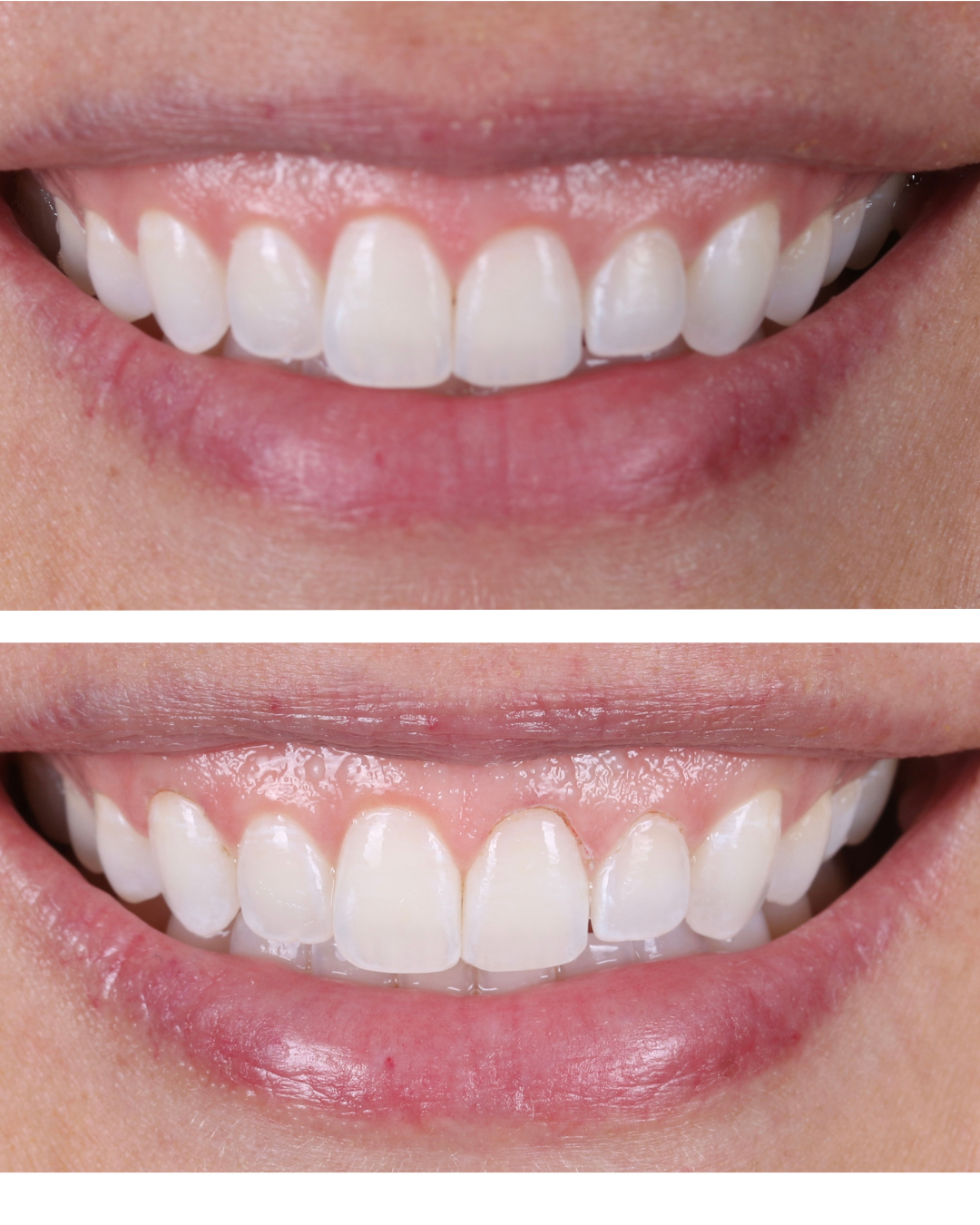
Who Gum Contouring Is Right For
You're likely a strong candidate for gum contouring if you see yourself in one of these:
• You have a "gummy smile." When you smile naturally, more gum shows than you'd like. Often this isn't because the gums are abnormal — it's because the upper lip rises higher than average, revealing gum tissue that's usually hidden. Reshaping the gum line creates the illusion of longer, more proportioned teeth without changing anything about your lip.
• Your gum line is uneven from one tooth to the next. One front tooth looks shorter or longer than its neighbor. The two front teeth are at different gum heights. The canines look uneven with the laterals. These small asymmetries are what your eye notices when a smile feels off, even if you can't name why.
• Your teeth look short. They may not actually be short — they may just be partially covered by excess gum tissue. Reshaping the gum can reveal tooth length that was already there.
• You're planning veneers or a smile makeover. This is the most important use case, and the one most cosmetic dentists overlook. (More on that below — it's the entire reason I do this procedure in my own office instead of referring it out.)
• You've been told you need "crown lengthening" for a cosmetic reason. In many cosmetic cases, what's really needed is gum contouring — a lighter, in-chair, laser-based reshape — not full surgical crown lengthening.
You're probably not a candidate if:
• Your gummy smile is caused by jaw position or muscle activity, not gum tissue. Some gummy smiles need orthodontics, Botox, or in rare cases orthognathic surgery — not gum reshaping. I'll tell you honestly at your consultation if that's your situation.
• You don't have enough attached gum tissue to safely reshape. The laser is precise, but it still needs healthy tissue to work with. I'll evaluate this during your exam.
• You're hoping to fix a single tooth that erupted partially. That's typically a different procedure (often a true crown lengthening with a periodontist), not cosmetic gum contouring.
Facially Driven Smile Design + Gum Contouring
This is the part of the conversation that almost no other Chicago cosmetic dentist is having with their patients, and it's the reason I keep this procedure in-house instead of referring it out.
I design every smile using a philosophy I call Facially Driven Smile Design. I don't design teeth in isolation. I design them in relation to your face shape, your jawline, and the way your upper lip drapes over your teeth when you talk, smile, and rest. The teeth and gums sit inside a frame — your face — and they only look right when they're balanced to that frame.
The gum line is part of that frame.
Here's what changes when you start thinking about smiles this way:
• Tooth length is a gum decision as much as a tooth decision. If your upper lip drapes high when you smile and your gum line sits low on the teeth, your teeth will look short no matter what you do to the tooth itself. The fix isn't longer veneers — it's a higher, more refined gum line. Otherwise the veneers will look bulky, square, and overdone.
• Gum symmetry matters more than tooth symmetry. The eye notices asymmetry in the gum line before it notices asymmetry in the teeth. A patient can have beautifully shaped veneers and still look "off" because the gum heights aren't matched correctly to the face's midline.
• Upper lip drape sets the rules. How much of your tooth — and how much of your gum — is visible when you smile is dictated by how your upper lip moves. I design the gum line in relation to that movement. If I reshape gum tissue without watching your lip in motion, I'm guessing.
This is why I do gum contouring myself, in my own office, on the same day or same visit cluster as I do the rest of the cosmetic work. The gum line is a design element, not a separate procedure. Handing it off to another office means handing off part of the smile design — and that's not how I work.
If you've ever looked at someone's "perfect" veneers and thought something is off, but I can't tell what — about 70% of the time, it's the gum line. Either the proportions are wrong, or the symmetry isn't there. Most of those cases were planned without the gums being considered as part of the design.
Gum Contouring in Conjunction with Veneers
The most common version of this procedure in my practice is gum contouring paired with porcelain veneers in a smile makeover.
Here's why they pair so well:
1. We're already designing the smile from scratch. When we're planning veneers, we're already deciding tooth length, shape, edge position, and proportion. Adding the gum line to that conversation costs almost nothing in extra time — and it changes the final result dramatically.
2. The veneers can be shorter and more natural-looking. If we reshape the gum line first (or simultaneously), the tooth has the right vertical proportion before we add porcelain. The veneer doesn't have to overcompensate by being long, square, or bulky. The final teeth look refined instead of overbuilt.
3. The midline and gum line can be aligned to the face, not the existing teeth. Most patients have a slightly off-center smile, slightly canted gum line, or asymmetric arch — small things they've stopped noticing. With contouring + veneers, we get to reset everything to your face, not to where the teeth happened to grow in.
4. One healing window, not two. When done together, the gum work heals during the same window that we're preparing veneers in the lab. By the time the final veneers are bonded, the gum tissue has settled into its new position.
In practice, this looks like one or two visits where the gum contouring happens first, you heal for a few days to a couple of weeks, and then we move into the veneer phase. Sometimes — for smaller cases — we do everything in a tighter sequence over the same visit cluster.
It's the same philosophy I apply to smile makeovers and to my broader cosmetic dentistry work: every element of the smile gets designed together, not in isolation.
What to Expect
Step 1: Consultation + Photos
You come in, we talk through what's bothering you about your smile, and I take a series of photos — full-face, smile in motion, retracted views of your teeth and gums. I want to see how your upper lip drapes over your teeth when you smile naturally, because that's what dictates the gum line we're going to design.
Step 2: Digital Mockup
For most patients, I'll build a digital preview so you can see the projected gum line and tooth proportions before we touch anything. If we're combining contouring with veneers, you'll see the full smile design — both gum and tooth changes — at this stage.
Step 3: The Procedure
On treatment day, we apply a topical anesthetic to the gum tissue. Some patients also opt for a small amount of local anesthetic, but many don't need it. The laser sculpts the gum line precisely, following the design we agreed on. For most cases, the entire treatment takes about 30 minutes — sometimes less for smaller corrections.
Step 4: Healing
You'll leave the office with detailed aftercare instructions. Most patients describe the first day as mildly sore — similar to a minor scrape — and the discomfort resolves quickly. Soft foods for a day or two, gentle brushing around the area, and you're typically fully healed within a week.
Step 5: Follow-Up
I'll see you back for a quick check on healing and final shaping if any micro-refinement is needed. If we're combining with veneers, this also becomes the start of the veneer planning phase.
Pricing
Laser gum contouring is priced transparently, with all-in fees quoted up front before treatment begins. No surprise add-ons. Starting points:
• Single-tooth touch-up — from $250
• Smile-zone reshape (3–6 teeth) — from $750
• Full upper smile contouring — from $1,000
• Paired with veneers or a smile makeover — the gum work is priced as part of the overall smile design plan, not a separate referral cost layered on top.
We offer low- to no-interest financing through CareCredit®, accept all major credit cards, and walk through every payment option at your consultation.
A note on insurance: cosmetic gum contouring is not covered by dental insurance, regardless of provider — it's an elective cosmetic procedure.
Meet Dr. Brittany Dickinson
I'm a cosmetic dentist in Lakeview, Chicago, and a member of the American Academy of Cosmetic Dentistry (AACD). I design every smile in my practice using Facially Driven Smile Design — a philosophy that positions teeth and gums in relation to your face shape, jawline, and upper lip drape, rather than to a textbook ideal.
The reason I do gum contouring in my own office, instead of referring it out like most cosmetic dentists, is simple: the gum line is part of the smile I'm designing. Handing it off means handing off part of the design. I'd rather keep the whole picture in one set of hands.

Frequently Asked Questions
-
A: For most patients, no. We use a topical anesthetic on the gum tissue, and most people describe the procedure as a warm or tingling sensation rather than a cutting feeling. Some patients opt for a small amount of local anesthetic for extra comfort, but it's not always necessary. Post-procedure soreness, if any, is usually mild and resolves within a day or two.
-
A: Most cosmetic gum contouring cases take about 30 minutes in the chair. Smaller corrections can be even faster. Larger combined cases — for example, contouring across the full upper smile in conjunction with veneer planning — may take longer, and we'll walk you through the timeline at your consultation.
-
A: For the vast majority of cosmetic cases, yes — the reshaped gum line stays in place. Gum tissue is stable once it heals, and the new contour becomes your new baseline. In rare cases, minor regrowth or rebound can happen, which is why I do a follow-up visit to check healing and refine if needed.
-
A: Laser gum contouring is one of the lower-risk cosmetic procedures in modern dentistry. The main risks are mild post-procedure soreness, temporary tooth sensitivity at the gum line, and (very rarely) minor regrowth. I evaluate every patient carefully before treatment to make sure you have enough healthy attached gum tissue to safely reshape — patients who don't are not candidates.
-
A: Most patients are fully healed within a week. Day one is the most noticeable — mild soreness, similar to a minor scrape inside the mouth — and most people return to normal activity right away. Soft foods for the first day or two, gentle brushing around the area, and you're back to normal quickly.
-
A: Yes — and for many patients, this is the ideal sequence. We typically do the gum work first so that the tissue can heal into its new position before the veneers are designed and bonded. This produces a more refined, natural-looking final smile than veneers placed against an unaddressed gum line.
-
A: They're usually used to describe the same family of procedures — reshaping the gum line for cosmetic reasons. "Gum lift" tends to be used when the focus is on lifting the gum higher to create longer-looking teeth (as in a gummy smile correction). "Gum contouring" is a broader term that includes leveling unevenness, refining proportions, and adjusting individual teeth. In practice, you may hear me use either word — I'm describing the same in-office laser procedure.
-
A: Several reasons. The laser is significantly more precise, which matters when we're sculpting fractions of a millimeter to balance a smile. It cauterizes as it works, which means very little bleeding and no stitches. Recovery is dramatically faster than scalpel-based gum surgery — days, not weeks. And the procedure itself is far more comfortable for the patient. Scalpel gum surgery has its place in true surgical periodontics, but for cosmetic gum reshaping, the laser is the better tool.
-
A: That's the entire goal of the design phase. I plan every case using Facially Driven Smile Design — designing the gum line to look right against your specific face, lip drape, and tooth proportions. The aim isn't a generic "ideal" gum line; it's a gum line that looks like it was always supposed to be there, on your face.
Sometimes the smile you've been wanting isn't about the teeth at all.
If you've been told you need veneers, or you've stared at your smile and known something was off without being able to name it — the answer might be a 30-minute laser appointment, not a full set of veneers. Let's find out.
See more of my work in the before & after gallery.