

Veneers vs. Crowns: Which One Do You Actually Need?
If you've been told you "need a crown or a veneer" — and walked out of the appointment unsure which one you actually need, or why — you're not alone. It's one of the most common questions I hear in consultations at Chicago Aesthetic Dentistry, and the answers patients have usually been given are, frankly, a little thin.
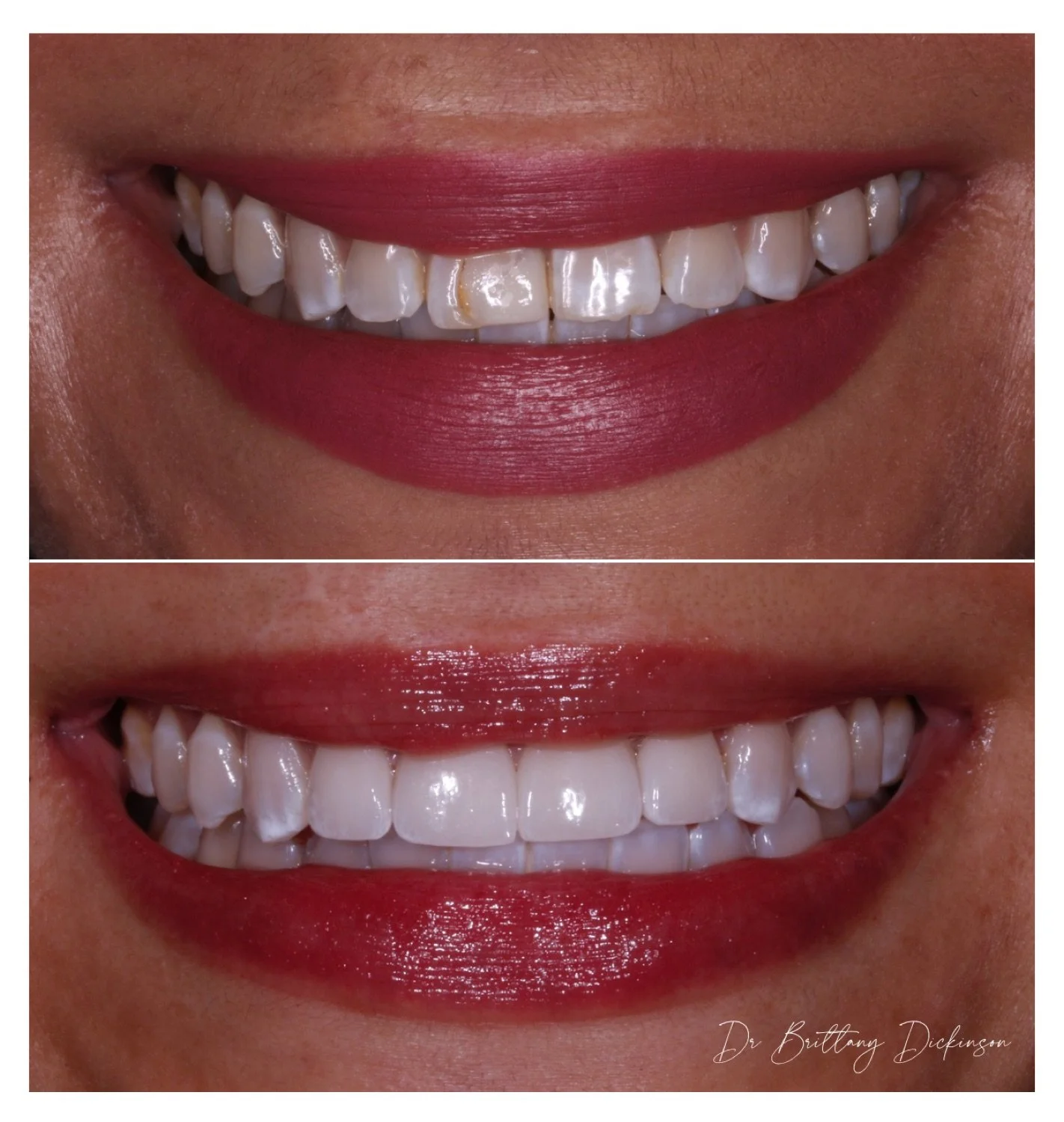
The truth is, veneers vs. crowns isn't really a comparison. They're two different tools designed to solve two different problems. The question worth asking isn't "which is better." It's "which one does this specific tooth actually need?" That's the conversation I want to walk you through here.
I'm Dr. Brittany Dickinson. I'm a cosmetic dentist in Lakeview, Chicago, and I've spent sixteen years restoring and redesigning smiles — most of them for patients who've been quietly weighing this exact question for years. Here's how I think about it.
What a Porcelain Veneer Actually Is
A porcelain veneer is a thin, custom-shaped shell of dental porcelain bonded to the front surface of a tooth. Think of it like a designer's overlay — it changes the shape, the shade, the proportion, and the way light moves through the tooth, while leaving most of the underlying tooth structure intact.
Veneers are a cosmetic restoration. They exist to change how a tooth looks. They're typically placed on the front teeth — the ones that show when you smile — because that's where shade and shape matter most. A well-designed veneer doesn't look like a veneer. It looks like a slightly better version of the tooth that was already there.
The conservative, minimally invasive technique I use removes only a fraction of a millimeter of enamel — sometimes none at all, depending on the case. That preservation matters more than most patients realize. Your enamel doesn't grow back, and the less of it we remove now, the more options you have at every dental decision for the rest of your life.
What a Dental Crown Actually Is
A dental crown is a full-coverage cap. It surrounds the entire visible portion of the tooth — front, back, sides, biting surface, everything. The tooth underneath has to be reduced significantly to make room for it.
Crowns are a restorative restoration. They exist to rebuild a tooth that's been structurally weakened — by a large cavity, a fracture, a root canal, severe wear, or a previous restoration that's failing. The job of a crown is to hold a damaged tooth together and let it function for another decade or two.
Crowns can absolutely look beautiful. Modern porcelain materials let me match shade and shape with a level of precision that wasn't possible even ten years ago. But the purpose of a crown is structural. The aesthetic outcome is secondary to the rebuild.
The Real Question Isn't Veneer vs. Crown — It's "What Does This Tooth Need?"
Here's the framing I use in consultations. I'm not choosing between two products on a menu. I'm reading the tooth.
If the tooth is structurally sound and the patient wants to change how it looks — shade, shape, length, alignment of the front edge — a veneer is almost always the right tool. We can preserve the existing tooth, redesign the surface, and call it done.
If the tooth is compromised — a large old filling that's reaching the limit of what bonding can hold, a fracture line running through the structure, a root canal that's left the tooth brittle — a crown is the right tool. It's not a cosmetic decision at that point. It's a structural one.
And here's the part most patients don't get told: there are cases where the same tooth could go either way, and the right answer depends on what we're prioritizing.
A patient came in last year — front tooth with a chip and a small old filling, otherwise healthy. Another dentist had recommended a crown. When I looked at it, the tooth had enough sound structure that a conservative veneer would work beautifully and preserve more of her natural tooth. We went with the veneer. Six years from now if anything ever changes, she still has more options because we didn't reduce the underlying tooth more than necessary.
That's the kind of decision that shouldn't be made on a treatment plan you're handed at the door. It should be made in a conversation.
What About Cost?
This is where most articles get vague. I'd rather be direct.
Costs in Chicago for both procedures vary by case complexity, the material used, and the experience level of the dentist doing the work. At my practice, our veneer pricing is built into the Smile Design Consultation conversation because veneers are almost never a single-tooth decision in cosmetic cases — they're a planning decision about the whole smile.
A crown for a structurally compromised back tooth and a porcelain veneer redesigning the front of your smile are different investments because they're different work. What I'd push back on is choosing the cheaper option without understanding what you're solving for. A crown placed where a veneer would have worked is irreversible — you can't put enamel back. A veneer placed where a crown was actually needed risks failure within a few years. The cost of getting it wrong is always higher than the cost of getting it right the first time.
How to Know What You Actually Need
A few signals worth paying attention to:
If the goal is purely cosmetic — shade, shape, length, proportion, closing a small gap — and the tooth itself is healthy, you're almost certainly a veneer candidate.
If the tooth has had a root canal, a large filling that's been replaced more than once, a visible crack, or a chip that involves more than the front surface — a crown is usually the right tool.
If you've been told you "need" one or the other and you don't fully understand why — that's your signal to ask for a second opinion. A good cosmetic dentist will be able to walk you through the why in plain language, with photos of your tooth, and explain what the alternative would mean for the long term.
The other thing worth saying out loud: the dentist who designs your smile should be the dentist who places the work. Veneer placement is a precision art. So is crown shaping on a front tooth. The advisor and the artist need to be the same person.
What This Looks Like at Chicago Aesthetic Dentistry
When a patient comes to me weighing veneers vs. crowns, the consultation isn't a sales pitch. It's a planning conversation. I look at the tooth, the bite, the surrounding teeth, the way your smile sits in your face, the long-term plan for your enamel. Then I show you what each option would look like and what each one would mean — for the next two years, and for the next twenty.
The work I'm known for is facially driven smile design — I position teeth based on your face shape, your jawline, and the way your upper lip drapes, not on a textbook ideal. That same principle applies whether we're talking about a single crown, a single veneer, or a full upper redesign. The goal is always a tooth that looks like it belongs to you.
If you've been trying to figure out which restoration is the right one for your smile — and you'd like a clear, honest answer — the Smile Design Consultation is where that conversation starts. We sit down, we look at what your teeth are actually doing, and we map a plan that respects your face, your timeline, and your long-term oral health.
Book your Smile Design Consultation →
Chicago Aesthetic Dentistry · 3346 N. Paulina St., Lakeview Chicago · 773-883-1818