

How Long Do Porcelain Veneers Actually Last? A Chicago Cosmetic Dentist's Honest Answer
"How long do porcelain veneers actually last?"
It's one of the first questions every careful patient asks in a Smile Design Consultation — and it's the right question. You're considering an investment that you want to enjoy for as long as possible, and you're trying to figure out whether you're signing up for a one-time decision or a recurring expense.
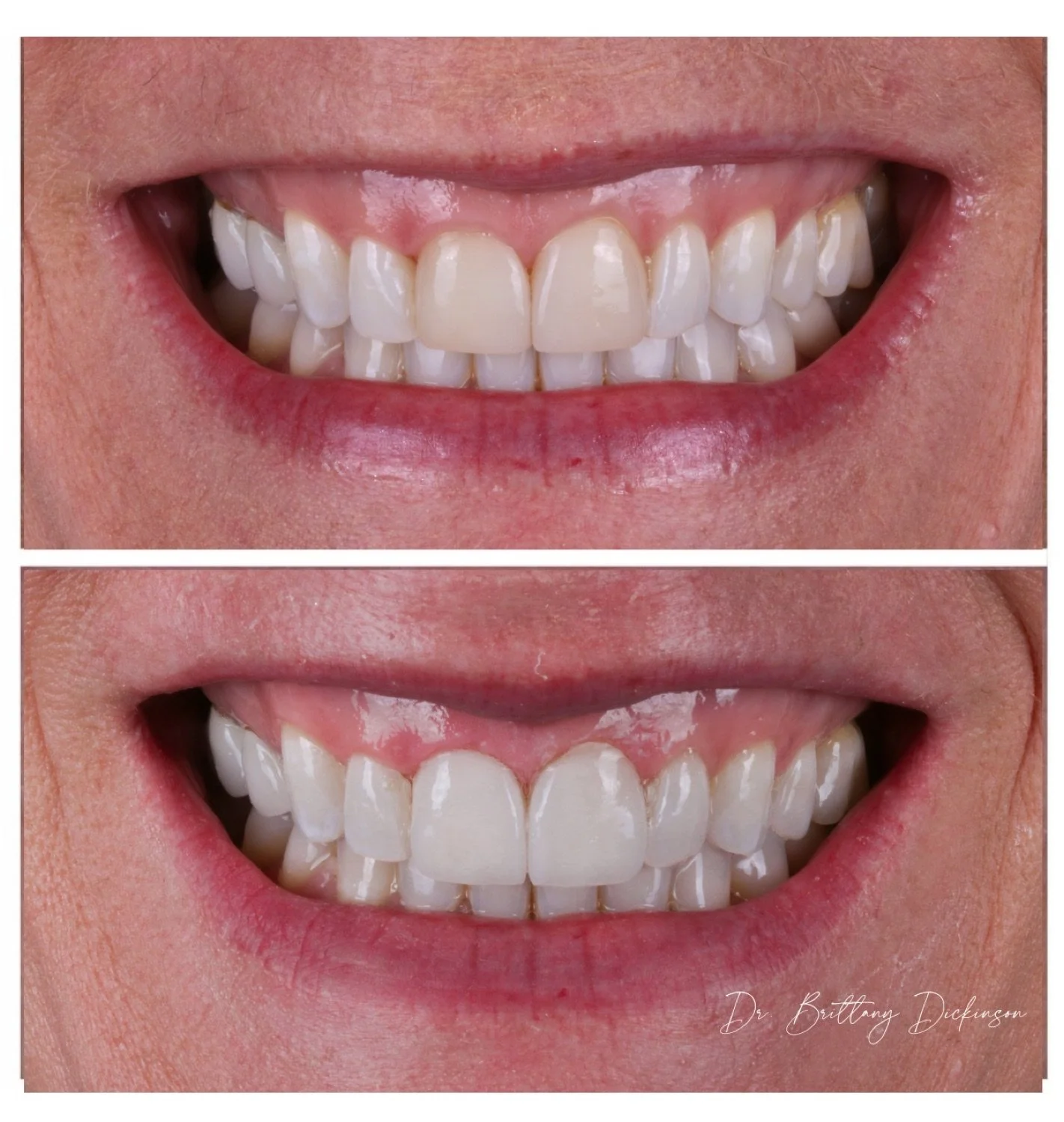
I'm Dr. Brittany Dickinson, a cosmetic dentist in Lakeview, Chicago. I'm going to give you the honest answer here — not the inflated one some marketing copy will throw at you. The real range matters, because if you walk in thinking your veneers will last twenty years and they need replacement at year twelve, you're going to feel cheated. I'd rather you walk in knowing exactly what to expect, and walk out delighted because your veneers outperform it.
The Range: 10 to 15 Years
Well-designed, well-placed porcelain veneers typically last 10 to 15 years. Some last longer. A few last shorter. The patients whose veneers are still pristine at year 12 and beyond have a few things in common, and we'll get into those.
You'll see some articles online claim 15–20 years, or even 20+ as a standard expectation. I don't think that's honest. It sets patients up to feel disappointed at year 13. The clinical truth is that 10–15 years is the realistic working range for most patients with high-quality porcelain, well-placed, well-cared-for.
What that means in practice: think of veneers the way you'd think about any premium investment that lives in a working environment. They're built to be durable, but they're also living in your mouth — chewing, talking, occasionally clenching at night, occasionally biting into something you shouldn't have. The fact that high-quality porcelain holds up for over a decade in those conditions is, frankly, remarkable.
What Actually Determines How Long Veneers Last
Here's where the variation comes from. Four factors do most of the heavy lifting:
1. The quality of the porcelain itself. There's a real range in materials. The lab I work with uses high-end porcelain that's stronger, more translucent, and bonds more reliably than the entry-level options. Cheaper porcelain breaks down sooner — the surface micro-cracks, the bond fatigues, and you see chips and shade shifts at the edges. This is one of the reasons I never compete on price. You can't shortcut the material and expect the lifespan.
2. The skill of the dentist who designs and places them. Veneer placement is a precision art. The bond between porcelain and tooth is everything. A veneer placed with even slightly contaminated bonding surfaces — saliva, blood, moisture — will fail years before its time. A veneer placed with perfect bond protocol will outlast the average.
The dentist who designs your smile should also be the dentist who places the veneers. Continuity of judgment matters at every step. I personally design and place every veneer in my practice.
3. How well the underlying tooth was preserved. This is where the conservative approach pays dividends a decade later. When we remove only the thinnest layer of enamel necessary, we're preserving the strongest, most predictable bonding surface there is. Aggressive prep — where the dentist removes a lot of enamel down to dentin — bonds less reliably and ages less gracefully. The veneers I place are designed to preserve as much of your natural tooth as possible, which is part of why my patients see the long end of the longevity range.
4. How you take care of them. We'll talk about this next. Spoiler: it's not complicated, but it's not optional.
How to Make Your Veneers Last as Long as Possible
There's no magic to veneer aftercare. There's just consistency. Here's what I tell every veneer patient at the post-op visit.
Wear a nightguard. I require this for every veneer patient — not just the patients who tell me they grind, but every patient. Most people clench or grind at night without realizing it, and the forces involved are far greater than anything you do during the day. A custom nightguard is the single most important thing you can do to extend the life of your veneers. It's also the cheapest. The nightguard is included in the Smile Design treatment plan for that reason.
Maintain your dental hygiene. Brush twice a day. Floss daily. The porcelain itself doesn't get cavities, but the natural tooth it's bonded to absolutely can — and decay at the edge of a veneer is one of the most common reasons we'd need to replace one before its time.
Keep your professional cleanings on schedule. Twice-yearly cleanings let us watch the margins of your veneers, catch any small issue years before it becomes a real one, and keep the porcelain polished to its original luster.
Be reasonable about what you bite. I'm not going to tell you to live in fear. I will tell you that biting into hard candy, opening packaging with your teeth, or chewing ice will eventually find the weakest link. The same is true for natural teeth, by the way. Veneers don't need to be coddled. They just don't need to be punished either.
See your cosmetic dentist annually. A quick check at the year mark — not just at your hygiene appointment — lets us catch any small issue early and refresh the polish. The patients who treat their veneers like the premium investment they are tend to get the long end of the lifespan.
What Happens When Veneers Eventually Need to Be Replaced
This is the conversation most patients haven't been having, and they should. When a veneer reaches the end of its life — whether at year 11 or year 17 — replacement is usually a redesign moment, not a one-for-one swap.
Why? Because the porcelain materials, the design software, the photography tools, and our understanding of facial aesthetics all keep evolving. A patient whose original veneers were placed in 2014 is going to get a meaningfully better result in 2029 — same conservative philosophy, better tools.
Replacement is generally simpler than the original placement. We're working with a tooth that's already been prepared and bonded, and the new veneer slots into the same architecture. The cost is typically in line with the original per-tooth investment, sometimes slightly less, because the design work was already done the first time.
A Quick Note on "Permanent" Veneers
You'll see veneers called "permanent" online. They're not. Nothing in dentistry is. What they are is long-term, durable, and predictable — when they're well-designed, well-placed, and well-cared-for. Calling them permanent is marketing language, and it's the language that sets patients up to feel betrayed at year 12.
Honest language is better. Veneers are a 10–15 year investment in a smile you'll love every day of those years.
What I'd Want You to Know Before You Decide
If you're researching veneers right now, here's the short version of what matters most for longevity:
Choose a cosmetic dentist whose philosophy is conservative — preserving as much of your natural tooth as possible. This protects your enamel and extends the lifespan of the veneers.
Make sure the dentist who designs your smile is the one who places it. No handoffs.
Wear the nightguard. Every night.
Treat your veneers like a premium investment, because they are.
Do all that, and 10–15 years is your floor — not your ceiling.
The Conversation We'd Have at Your Smile Design Consultation
If you've been weighing veneers and want to walk through the longevity question in detail — what the long-term plan looks like, what your enamel allows for, what kind of investment timeline makes sense for your smile — the Smile Design Consultation is where that conversation lives. It's not a sales pitch. It's a planning session, with a smile preview so you see exactly what we'd build before anything is permanent.
Book your Smile Design Consultation →
Chicago Aesthetic Dentistry · 3346 N. Paulina St., Lakeview Chicago · 773-883-1818