

Should You Whiten Before or After Veneers? A Cosmetic Dentist Explains
Here's a question I get almost every week at consultations: "I want veneers, but I also want to whiten my teeth. Which do I do first?"
The answer matters more than most patients realize. Getting the order wrong can cost you thousands of dollars, force you to redo cosmetic work, or leave you with a smile where your veneers and natural teeth don't match — and no amount of future whitening can fix it.
Let me explain, straightforwardly, exactly how to think about this.
I'm Dr. Brittany Dickinson, cosmetic dentist and owner of Chicago Aesthetic Dentistry in Lakeview, and a member of the American Academy of Cosmetic Dentistry (AACD). This is one of the most important sequencing decisions in cosmetic dentistry, and here's how we handle it.
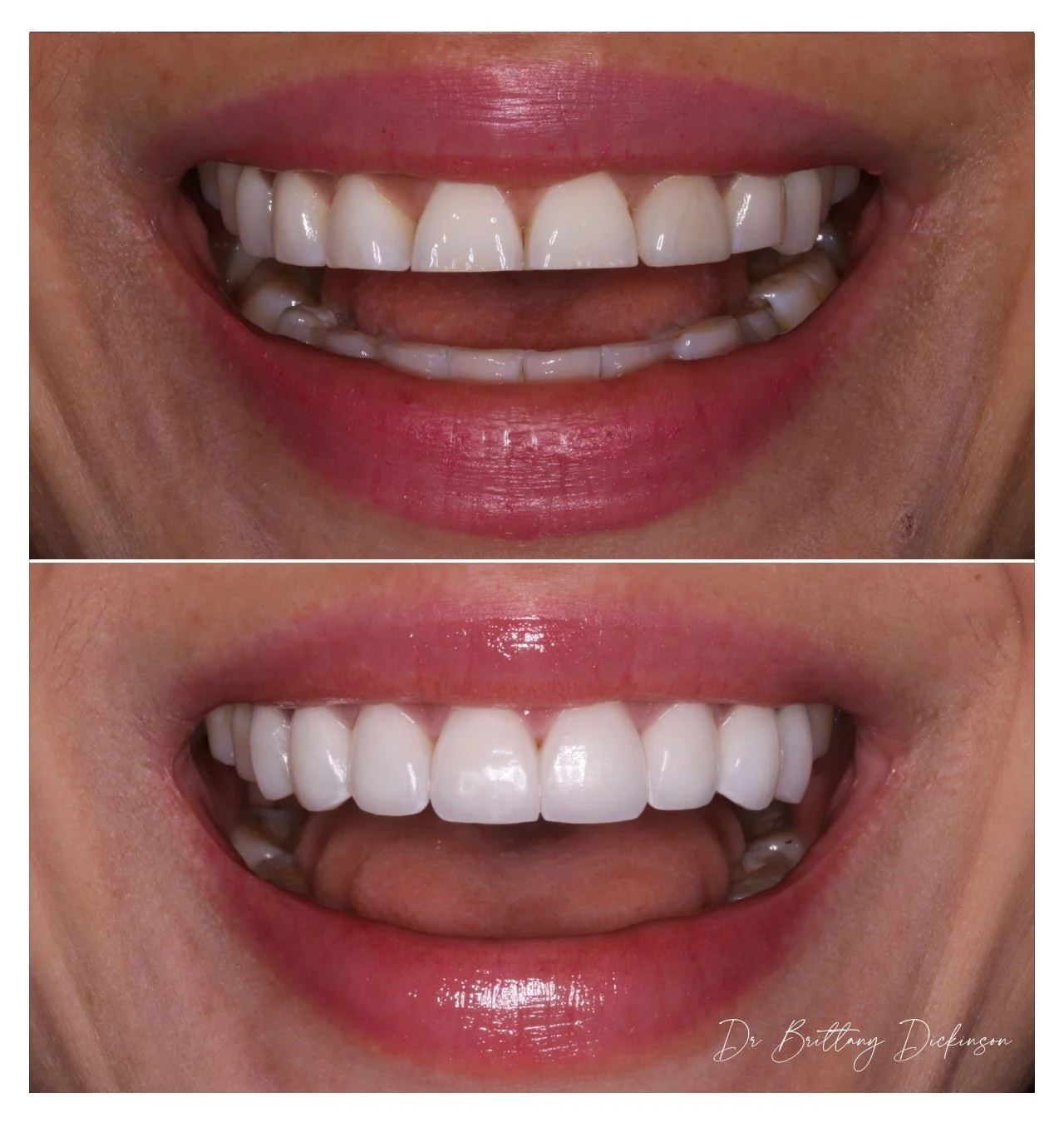
The short answer
Whiten first. Always.
Veneers are a set color. Once they're bonded onto your teeth, their shade is locked in for the next 10–15 years. Whitening treatments have zero effect on porcelain — they only affect natural tooth structure.
So if you place veneers first and then decide later that you want a whiter smile, your only options are:
Whiten only your natural (non-veneered) teeth, which then look brighter than your veneers — creating a mismatch you can't hide
Replace all your veneers with lighter ones — thousands of dollars, weeks of chair time, unnecessarily invasive
Neither is a good outcome.
The right sequence, step by step
For patients doing a partial smile makeover — say, veneers on the front 6 or 8 teeth — the correct sequence is:
Step 1: Whiten your natural teeth first
We start with 4–8 weeks of professional whitening on all of your natural teeth. You get to a shade level you love and feel confident wearing forever.
At my practice, we offer two whitening systems:
KöR Deep Bleaching System — starting at $1,100. This is the highest-strength take-home whitening protocol available. It works for patients with tetracycline staining, deep intrinsic staining, and other cases where standard whitening plateaus. Best-in-class results.
Zoom Whitening Pen — $50. Great for maintenance touch-ups between deeper treatments or for patients with mild surface staining.
Both are safe for sensitive teeth when used under supervision. We coach you through it — dose, timing, protocol — so you get the maximum result with minimum discomfort.
Step 2: Lock in the shade
Once you've reached your target shade, we let your teeth stabilize for 48 hours. This is important. Freshly whitened teeth can rebound slightly (they look a shade darker than peak) for the first 2 days. Bonding veneers to teeth that are still stabilizing means your final match will be slightly off.
We wait. Then we take shade photos.
Step 3: Design and place your veneers to match the whitened shade
Now the veneers get built to match — or even fractionally lighter than — your natural teeth. When we bond them, everything looks like one uniform, radiant smile.
Step 4: Maintenance whitening on your natural teeth going forward
Even after veneers, we keep your natural teeth at their whitened shade with periodic touch-ups. Because porcelain doesn't stain but natural teeth do, this is what keeps the whole smile looking uniform over the next decade. Usually just a few nights of touch-up trays every 12–18 months does the trick.
Why the "whiten first" rule is non-negotiable
I'll give you the practical, non-hedged reason: cosmetic dentists cannot mind-read the future.
If you get veneers now and decide in 6 months, or 3 years, or 10 years that you'd like a whiter smile, we have no way to give it to you without invasive, expensive work. The porcelain color is fixed. You lose optionality forever.
By whitening first, you preserve every future option:
You can keep your natural teeth at that whitened shade forever, and your veneers will always match
If you ever want to go lighter in the future (say, for a wedding photo shoot), you can whiten your natural teeth first, then we redesign only the veneers if needed — but you'll never be stuck
If you decide you're satisfied and never want to touch it again, that also works
Common questions patients ask
"But my veneers are going to cover the yellowest teeth anyway. Do I really need to whiten first?"
Yes. Because your back teeth, your lower teeth, and even the corners of your smile line will still show in most photos. If they're two shades darker than your new veneers, the effect is obvious in every close-up photo you take for the next 15 years.
"Can we just whiten and place veneers in the same appointment?"
No. Veneer adhesion is chemically compromised on teeth that were whitened within the last 2 weeks. The bonding is measurably weaker, which means the veneers may pop off within a few years. We won't shortcut this step.
"What if my teeth are already very white?"
Then we usually skip the whitening step and go straight to veneer design. But we'll still document the shade carefully so that any future maintenance whitening can match.
"What if I want my veneers whiter than my natural teeth can get?"
We can absolutely do that. In that case, we whiten your natural teeth to their max, then design veneers a couple of shades brighter, and keep your natural teeth at their whitest with maintenance. You'll never look at your smile and see a mismatch.
"What about full-mouth veneers — do I still need to whiten?"
If we're doing veneers on every tooth that shows when you smile (rare, but happens), whitening becomes optional. But most "full mouth" cosmetic cases are actually front-teeth cases with the back teeth still showing partially — so whitening usually still matters.
What happens if you already have veneers and want to whiten now
If you already had veneers placed elsewhere and now you're looking at yellowing natural teeth around them, here's the situation:
We can safely whiten your natural (non-veneered) teeth with a professional protocol
Your veneers will not change color
Depending on how big the shade gap becomes, we may end up recommending veneer replacement or refresh in a few years
This isn't ideal, but it's manageable. We do this a lot for patients who came from other practices.
The takeaway
Whitening is inexpensive relative to veneers. Doing it out of order — or skipping it and hoping — is one of the most expensive mistakes patients make in cosmetic dentistry. Doing it first, in the right protocol, under supervision, sets up every future decision to be flexible.
At your Smile Design Consultation, we'll assess your current shade, talk about how bright you want the finished result to feel, and build a real timeline that puts whitening in the right place. And if you're not sure you want veneers at all yet — that's fine too. Whitening alone changes a smile more than most patients expect.
Ready to book? Call 773-883-1818 or book a Smile Design Consultation online. Chicago Aesthetic Dentistry — 3346 N. Paulina St., Lakeview.