

Invisalign Attachments: What They Look Like, Why They Matter, and How to Stop Worrying About Them
A patient sat in my Lakeview consultation room last month and said: "I want Invisalign — but I read about the little bumps they glue on your teeth and I'm not doing that."
I hear some version of this every week.
It's one of the quietest reasons adults walk away from a smile they really do want. They get most of the way through deciding, then they see a TikTok about "Invisalign buttons" or "attachments" and back off because it sounds visible, painful, or ugly.
Let's clear this up. After over a decade of Invisalign cases in my Chicago practice, here's what attachments actually are, why your case may or may not need them, and what they really look like in real life.
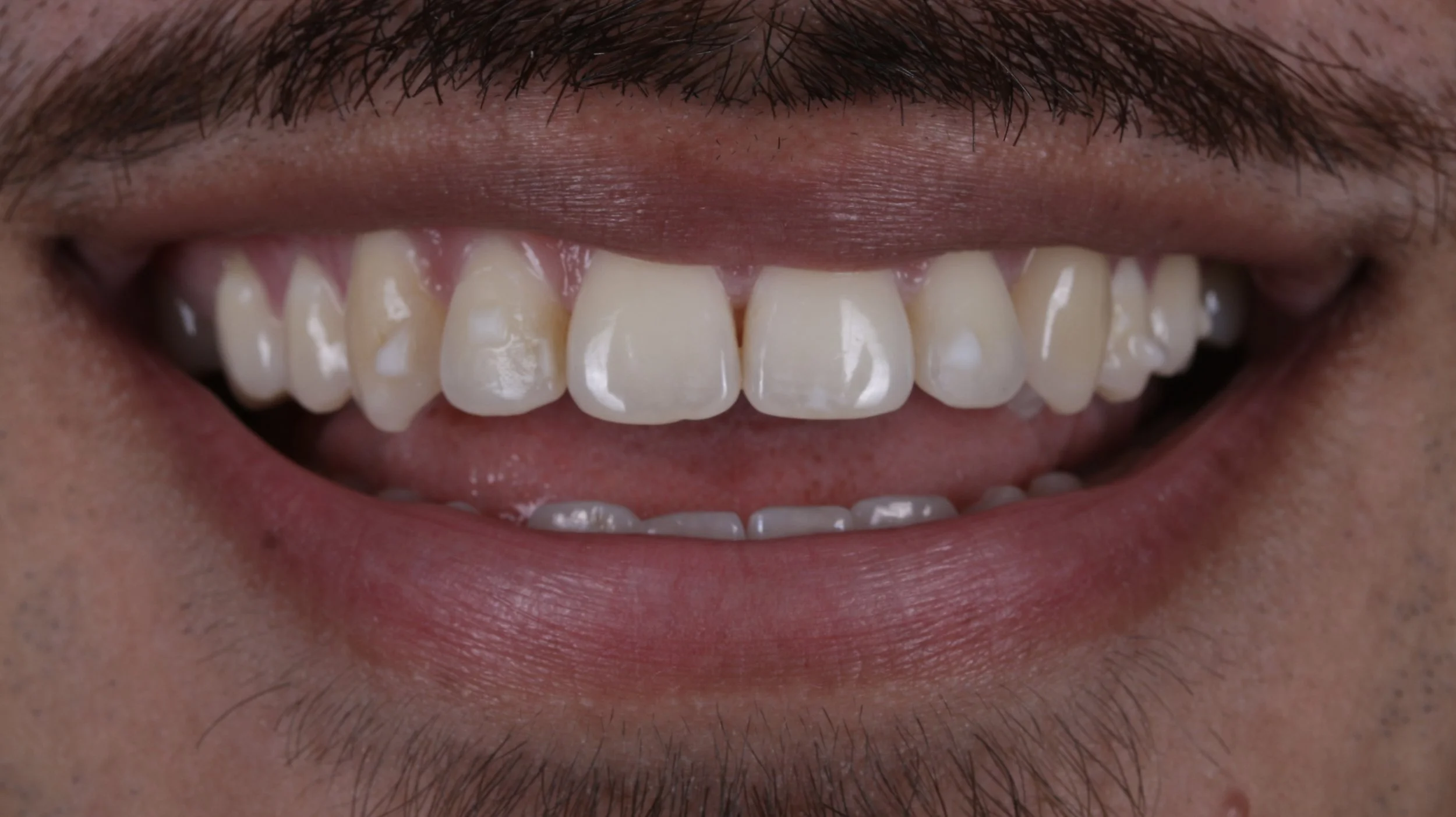
What Are Invisalign Attachments, Really?
Invisalign attachments are small, tooth-colored bumps that are bonded to specific teeth during your treatment.
Think of them as temporary handles that give the aligner something to grip. The clear plastic of an aligner is smooth, and certain tooth movements — rotation, extrusion, certain types of tipping — are hard to accomplish without a place for the aligner to push or pull from. Attachments give the aligner that grip.
They're made of dental composite (the same material we use for cosmetic bonding), shaded to match your natural tooth color, and bonded directly to the enamel using a procedure that takes about 20 minutes total. When your treatment is done, they're polished off completely. Your enamel is unchanged.
That's it. No drilling, no permanent change to the tooth, no metal, no pain.
Why Your Case May Need Them (And Why It's Actually Good News)
The most common question I get is: "Can I do Invisalign without attachments?"
Sometimes yes. For very mild cases — a small amount of crowding, minor alignment refinement, or a relapse-after-braces case — attachments may not be necessary.
But here's the part that surprises people: attachments are usually a sign your case is being planned thoughtfully.
The alternative to attachments isn't "easier Invisalign." It's "Invisalign that doesn't move the teeth all the way." Providers who skip attachments to make treatment seem simpler sometimes get partial results — the patient finishes treatment, but the teeth don't end up where the original plan promised. Then they need a refinement round, and another, and another.
When your provider plans attachments into your case from the start, what they're really saying is: "I'm going to give the aligners the leverage they need to actually deliver the result we discussed."
In facially driven smile design — the way I plan every case in my Chicago practice — precise tooth positioning matters enormously. A tooth that's 70% rotated into place looks subtly off under the lip. A tooth that's 100% positioned looks right. Attachments are often the difference between those two outcomes.
What They Actually Look Like
Here's the part most articles dance around.
In normal life, at conversational distance, attachments are barely noticeable. They're tooth-colored, small, and worn underneath a clear aligner most of the time. Most of my patients tell me their coworkers, friends, and clients never mention them.
Up close, in good light, with the aligner removed, you can see them if you're looking. They're small bumps on the front of specific teeth. Some patients are completely unbothered by them. A small number are self-conscious for the first week or two, and then forget about them entirely.
A few realistic notes:
Attachments on front teeth (incisors and canines) are slightly more visible than attachments on premolars and molars
When you smile widely with the aligner OUT, you can see them more clearly
When the aligner is IN — which is 20–22 hours a day — the plastic actually camouflages them
If you're someone who is very particular about how your teeth look during treatment, we can talk through which teeth need them and whether there are any acceptable alternatives in your specific plan
I won't tell you they're invisible. They're not. But "you can sort of see them up close if you look" is a very different reality than "everyone will notice them."
Do They Hurt?
Placing them doesn't hurt. We clean the tooth, apply a small amount of dental composite, shape it, and cure it with a light. No drilling, no anesthesia. The whole appointment for placing all your attachments at once takes about 20 minutes.
For the first day or two, your tongue will notice them. You'll feel slightly rougher edges as your tongue runs along your teeth. This goes away within about 48 hours as your mouth adapts.
When the aligner is in, you may feel slightly more pressure than you would in a case without attachments — that's the leverage doing its job. This is the good discomfort. It means teeth are moving the way they should.
When the aligner is out, you feel nothing. You eat, drink, brush, and floss normally.
When We Remove Them
When you finish active Invisalign treatment, the attachments come off in about 15–20 minutes at your final visit. We carefully polish them off the tooth surface, smooth and re-polish the enamel, and your teeth go right back to looking exactly the way they did before — except now, they're in their new position.
There's no residual mark, no enamel damage, no change to the tooth structure. The bonding material releases cleanly from the enamel because the bond was designed to be reversible from day one.
This is one of the things I love most about Invisalign as a cosmetic-first treatment. We can do all the heavy lifting of moving teeth into the perfect cosmetic position, and when we're done, we leave the enamel untouched.
What This Means for Adults Considering Invisalign in Chicago
If you've been holding back on Invisalign because attachments felt like a dealbreaker, here's the takeaway:
They're small, tooth-colored, and bonded — not drilled or implanted
They come off completely at the end of treatment
They're usually a sign your case is being planned for a real, complete result
They're far less visible in real life than the close-up photos online suggest
They don't hurt, and they don't change how you eat, talk, or live
In my Lakeview practice, I'd rather have a conversation about attachments at the consultation than have a patient bail on a treatment they really wanted because the internet scared them.
How to Know If Attachments Are Right for Your Case
The honest answer: you don't know until you've had a real consultation with someone who's looking at your specific teeth, your specific bite, and your specific cosmetic goals.
When you come in for a Smile Design Consultation, we do a 3D scan, walk through your case visually, and tell you exactly which teeth would need attachments, how visible they'd be on you specifically, and what the trade-off would be if we tried to avoid them. No mystery.
If you're an adult in Chicago who's been quietly putting off Invisalign because of one small concern that nobody fully explained — let's get it explained.
Book your Smile Design Consultation →
Or call our Lakeview office at 773-883-1818. We're open Monday through Thursday.