

Invisalign Express vs. Full Invisalign: Which One Do I Actually Need? (A Chicago Cosmetic Dentist's Honest Guide for Lower Teeth Crowding)
You've already had the harder conversation with yourself.
You've decided your lower teeth are crowding, you don't love it, and you're done waiting. You've looked at the options, ruled out at-home aligner kits, ruled out veneers (which don't fix alignment anyway), and landed on Invisalign as the adult, refined, dentist-supervised choice.
Then you Google "Invisalign cost" and you land in a confusing place. There's Invisalign Express. There's full Invisalign. There's Invisalign Lite. There's something called Invisalign Comprehensive. The pricing ranges look enormous — $3,000 in one ad, $9,000 in another — and you have no idea which one you actually need.
Here's the clear decision guide, written for adults trying to make a real choice.
— — —
The Two Tiers That Actually Matter
Strip out the marketing names, and Invisalign comes in essentially two tiers for adults:
Invisalign Express — limited, short cases. Typically 5 to 7 sets of aligners. 3 to 6 months of treatment.
Invisalign Comprehensive (often just called "full Invisalign") — unlimited aligners and refinements. Typically 9 to 15 months of treatment.
That's it. There are other intermediate tiers Invisalign offers to providers (Lite, Moderate), but in practice, almost every adult case falls cleanly into one of these two. The decision between them isn't about marketing — it's about how much movement your teeth actually need.
At our Lakeview practice, the pricing is straightforward:
Invisalign Express: $5,500 all-in (including final retainer)
Invisalign Comprehensive: $7,000 all-in (including refinements and final retainer)
Both numbers include the retainer at the end of treatment. That matters more than it sounds. Most providers quote Invisalign without the final retainer and then bill you separately at the end — usually $400 to $600 per retainer, and you typically need both upper and lower. That can be a $1,000+ surprise. The number we give you on day one is the number you pay.
If you're a Lakeview or Lincoln Park resident wondering whether your lower-teeth crowding qualifies for the Express tier, here's [the full clinical breakdown of how we evaluate Invisalign Express candidates for lower-teeth crowding](https://chicagoaestheticdentistry.com/straightening-lower-teeth-crowding-in-lakeview-chicago).
— — —
Which One Do You Actually Need? The Honest Rubric
This is the part most blog posts skip, because it's specific and requires real opinions. Here's how I actually decide with a patient in the consult chair.
You're probably an Invisalign Express candidate if:
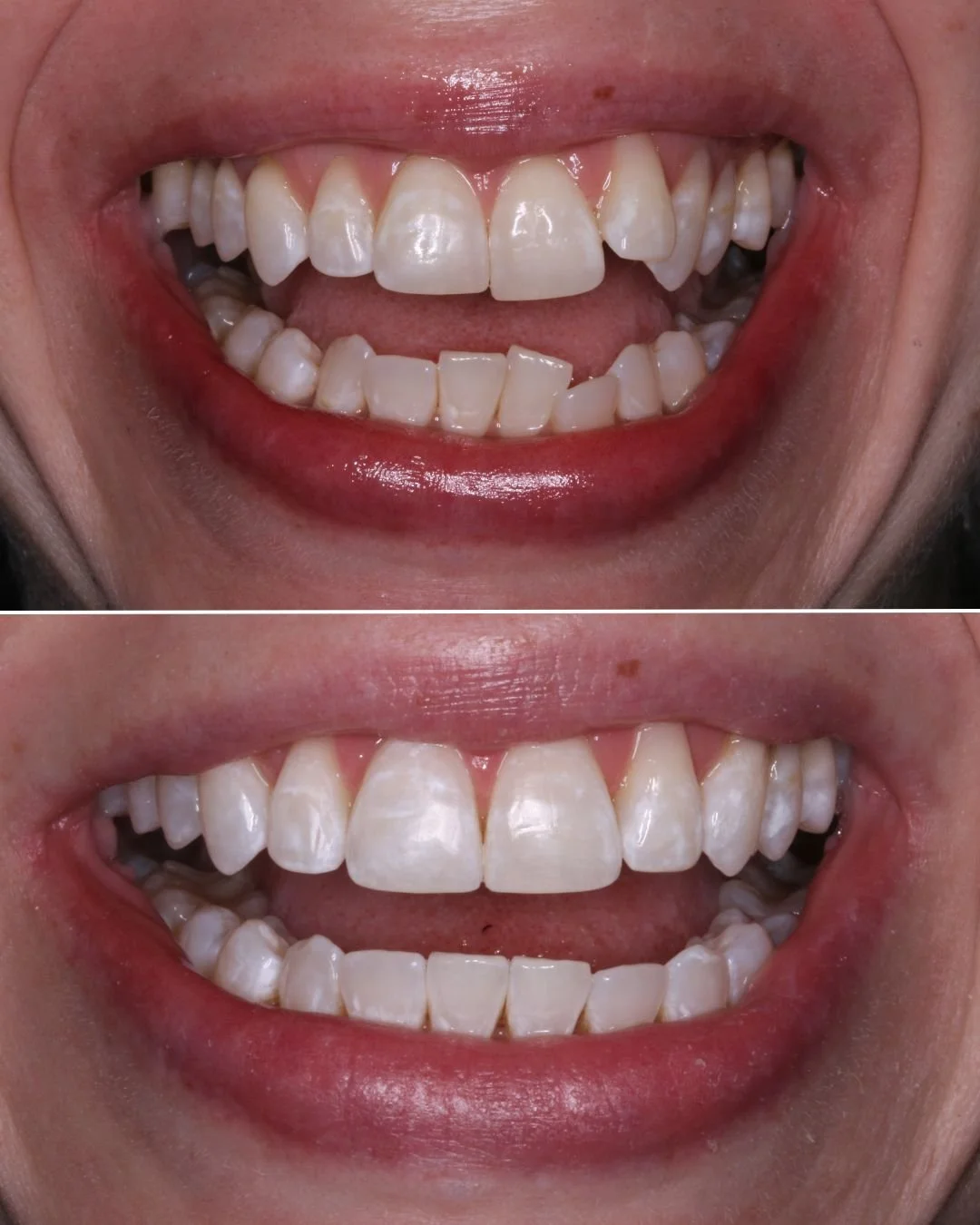
Your crowding is limited to the lower front 4 to 6 teeth, with the rest of the lower arch sitting reasonably well.
Your upper arch looks essentially fine to your eye.
Your bite closes evenly (your back teeth meet at the same time, no obvious shift).
You had braces years ago and the crowding is mild post-orthodontic relapse.
You don't have a significantly rotated tooth — small rotations are fine, but a tooth that's twisted 45° or more usually needs more aligner stages than Express can deliver.
You're motivated and consistent — Express has zero margin for slipping on wear time. The case is too short.
This is the bucket about 80% of adult lower-crowding patients at my practice fall into. If you're a busy professional in your 30s, 40s, or 50s who wore braces in middle school and is noticing your lower arch quietly going crooked again — there's a strong chance you're an Express candidate.
You probably need Invisalign Comprehensive if:
Your crowding extends beyond the front teeth — back teeth are also rotated or out of position.
Your bite is off — your back teeth don't meet evenly, your front teeth don't touch when you close, or you have a noticeable jaw shift.
Both your upper and lower arches need work.
You have moderate-to-severe spacing or rotations that need a higher number of aligner stages.
You want to combine Invisalign with veneers or other cosmetic work as part of a full smile makeover.
Comprehensive is the right call when there's more going on. It's not "the better version" of Express — it's the right tool for cases that are more complex. Choosing Express when you actually need Comprehensive almost always means finishing the case mid-result and being disappointed.
You probably don't need Invisalign at all if:
You have one or two very slightly rotated teeth and otherwise excellent alignment — composite bonding can sometimes resolve this faster.
Your crowding is severe enough that extraction-based orthodontics is actually the right answer (rare, but it happens — and an honest orthodontist will tell you).
— — —
The Cost Difference Isn't Just $1,500. It's What's Included.
Patients hear $5,500 vs. $7,000 and assume the difference is just $1,500 of additional aligners. That's not really what you're buying.
What Express buys you:
5 to 7 sets of aligners
One scan, one plan
One round of treatment — no refinements included
Final retainer
What Comprehensive buys you:
Unlimited aligners over the treatment window
Unlimited refinements — if at month 9 your teeth haven't quite landed where we planned, we re-scan and add another short round of aligners at no additional cost
More forgiveness if a tray cracks, gets lost, or you need to pause treatment
Better outcomes on complex cases because we have room to fine-tune
Final retainer
The refinement clause is the big one. With Express, what you scan on day one is what you get. If your case finishes slightly short of the plan, you pay separately for any additional aligners. With Comprehensive, that's built in.
For straightforward lower-teeth crowding cases, Express works because the case is short and predictable enough that refinements are rarely needed. For complex cases, the lack of refinements in Express becomes a real problem.
— — —
What If I Pick Express and It Turns Out I Needed Comprehensive?
This is a fair question, and honestly, it's why the consultation matters more than the price.
If we start a case as Express and run out of aligners before the result is fully refined, you have two options:
Pay for additional aligner sets (typically $500 to $1,500 depending on how many more we need)
Convert mid-case to Comprehensive — we credit your Express investment toward the Comprehensive price.
Neither outcome is catastrophic, but both are avoidable by getting the diagnosis right on day one. This is what the 3D scan + treatment-plan simulation at consultation is for. We don't guess. We see exactly how many aligner stages your case needs before anyone commits to Express vs. Comprehensive. If your case is borderline, I'll tell you. If your case is clearly one or the other, I'll tell you that too.
— — —
A Note on Pricing Transparency in Chicago
I'll get briefly direct here because patients ask this constantly.
If you've called around for Invisalign pricing in Chicago, you've probably encountered a confusing mix:
Some practices quote a wildly low "starting at" number that excludes scans, refinements, retainers, attachments, IPR, or follow-up visits.
Some quote a flat number but exclude the retainer (the surprise $500 charge at the end of treatment).
Some quote "depending on case complexity" without ever giving you a real number until you've sat through a sales presentation.
We don't do any of that. The pricing on our website is the actual price. It includes the scan, the aligners, all in-office visits during the treatment window, attachments, IPR if needed, and the final retainer.
If you're combining Invisalign with veneers as part of a smile makeover, the bundled pricing starts at $16,000 all-in ($7,000 Invisalign + $9,000+ veneers, scaling with case complexity).
[See our full Invisalign service page for the complete breakdown of timelines, attachments, retainer protocol, and what each appointment looks like.](https://chicagoaestheticdentistry.com/invisalign-chicago)
— — —
Why "Facially Driven Smile Design" Changes the Decision
There's one element of how I do Invisalign that affects the Express vs. Comprehensive decision more than people realize.
Standard Invisalign — the way most general dentists provide it — positions your teeth according to a textbook ideal. The Invisalign software auto-generates a plan, and the dentist mostly approves it. The teeth move to a generically "correct" position.
I override that. Every Invisalign case I plan is designed using what I call Facially Driven Smile Design — I position your teeth in relation to your face shape, your jawline, and specifically how your upper lip drapes when you speak and smile. This means I'm often making small adjustments to the default plan that the software wouldn't suggest — tilting a tooth a few degrees, adjusting the final position of a canine, leaving slightly more or less length on the lower incisors.
Why this matters for the Express vs. Comprehensive decision: Express has fewer aligner stages to work with. If your case needs the kind of nuanced final positioning that Facially Driven Smile Design calls for, and the software defaults wouldn't quite get you there, Comprehensive gives me the room to do that work. Express is best when the plan is clean and the default movements get you to the right answer.
For most lower-teeth crowding cases — where we're primarily aligning the bottom front teeth and not making major aesthetic decisions about the upper arch — Express handles the Facially Driven adjustments fine. For combined upper-and-lower cases or smile makeovers, Comprehensive gives me the room I need.
— — —
What to Bring to a Consultation
If you're considering Invisalign and want a clear, honest answer on Express vs. Comprehensive, the consultation is the one step that resolves everything. Here's what makes it productive:
Recent dental records if you have them — old X-rays, ortho records, photos. Helpful but not required.
Your honest history. Did you have braces? When? Did you wear retainers? For how long? If you grind your teeth at night, mention it. If you've been quoted Invisalign somewhere else, tell me what they said.
What you actually want. Some patients want full alignment perfection. Some want their lower arch to stop bothering them in photos. Both are valid goals; they lead to different treatment plans.
Realistic timeline. If there's a wedding, a milestone birthday, or a big professional moment in your calendar, tell me. We plan around it.
You walk out with: a 3D scan, a treatment-plan simulation, an all-in price, a recommended tier (Express or Comprehensive), and zero pressure to decide that day.
— — —
Quick Decision Rubric (Save This)
Choose Invisalign Express ($5,500) if:
Lower-teeth crowding only, mostly front teeth
Upper arch is fine
Bite is even
Mild to moderate movement needed
You'll wear aligners 20–22 hours/day religiously
Choose Invisalign Comprehensive ($7,000) if:
Both arches need work
Crowding extends beyond front teeth
Bite needs correction
You want unlimited refinements built in
Case is complex or smile makeover-adjacent
Skip Invisalign entirely and ask about other options if:
One or two minor rotations only (composite bonding may be faster)
Severe skeletal issues (orthodontic surgery consult may be more appropriate)
— — —
Common Questions
How accurate are these timelines, really?
Pretty accurate, with one honest caveat: timelines are based on wearing aligners 20–22 hours a day. If you average 16 hours a day because you keep "forgetting" them at dinners, an Express case that should be 4 months becomes 6 or 7. The math is the math. There are no shortcuts.
Can I switch from Express to Comprehensive mid-treatment?
Yes. We credit your Express investment toward the Comprehensive price. It's not common, but it happens — usually when a refinement need shows up mid-case. We'll always have that conversation transparently before any additional cost.
Does insurance cover Invisalign?
It varies enormously by plan. Our practice is out-of-network / fee-for-service, which means you pay us directly, but we submit the insurance paperwork on your behalf as a courtesy. Any reimbursement comes back to you directly from your insurer. Some plans cover up to $2,000 of orthodontic treatment per lifetime, some cover nothing. We can help you figure out what your specific plan offers before you commit.
Is Invisalign Express actually different from "Invisalign Lite" or "Invisalign Moderate"?
The naming has changed over the years. The functional answer is: there are short, limited-aligner cases (which I call Express), and there are unlimited-aligner cases (Comprehensive). Most marketing names map cleanly to one of these two buckets. Don't get distracted by the tier names — pay attention to the all-in cost, the aligner count, and whether refinements are included.
How do I know if my case is "borderline"?
You don't — and you shouldn't have to. That's what the consultation is for. If your case is genuinely borderline, I'll tell you. I'll show you the cost-benefit tradeoff of each tier for your specific teeth, and you can decide with full information. There's no benefit to me in recommending Comprehensive if Express is genuinely the right answer.
— — —
The Bottom Line
For most adult lower-teeth crowding cases — the kind that develops in your 30s, 40s, or 50s, isolated to the lower front teeth, with an otherwise reasonable bite — Invisalign Express is the right call. It's faster, more affordable, and built for exactly this kind of refined adult case.
If your case is more complex — both arches, bite correction needed, or combined with other cosmetic work — Comprehensive is worth the additional investment.
The only way to know for sure is the consultation. Thirty minutes, a 3D scan, an honest recommendation, and an all-in price. No pressure.
[See exactly how we evaluate and treat lower-teeth crowding cases at our Lakeview practice →](https://chicagoaestheticdentistry.com/straightening-lower-teeth-crowding-in-lakeview-chicago)
— — —
Dr. Brittany Dickinson is an AACD-member cosmetic dentist and practice owner of Chicago Aesthetic Dentistry, located at 3346 N. Paulina St. in Lakeview Chicago. She completed a 2-year Invisalign mentorship program in 2019 and has planned 200+ adult Invisalign cases. The practice is out-of-network and submits insurance paperwork on patients' behalf.