

Cosmetic Bonding for a Chipped Front Tooth: When It's the Right Fix (And When It Isn't)
You're eating lunch. You bite into something you've eaten a hundred times. You feel a small crunch that isn't food.
You run your tongue across the edge of your front tooth and — yes — there's a chip.
For most of my patients, the next hour is a quiet spiral. How bad is it? Can it be fixed today? Is my smile going to look weird until it is? Am I going to need a crown? A veneer? Is this a five-thousand-dollar problem?
I want to answer the version of that question I hear most often in my Lakeview practice: cosmetic bonding for a chipped front tooth. When it's the right fix, when it isn't, what it actually feels like, and what you should expect if this is your first time in the chair after a chip.
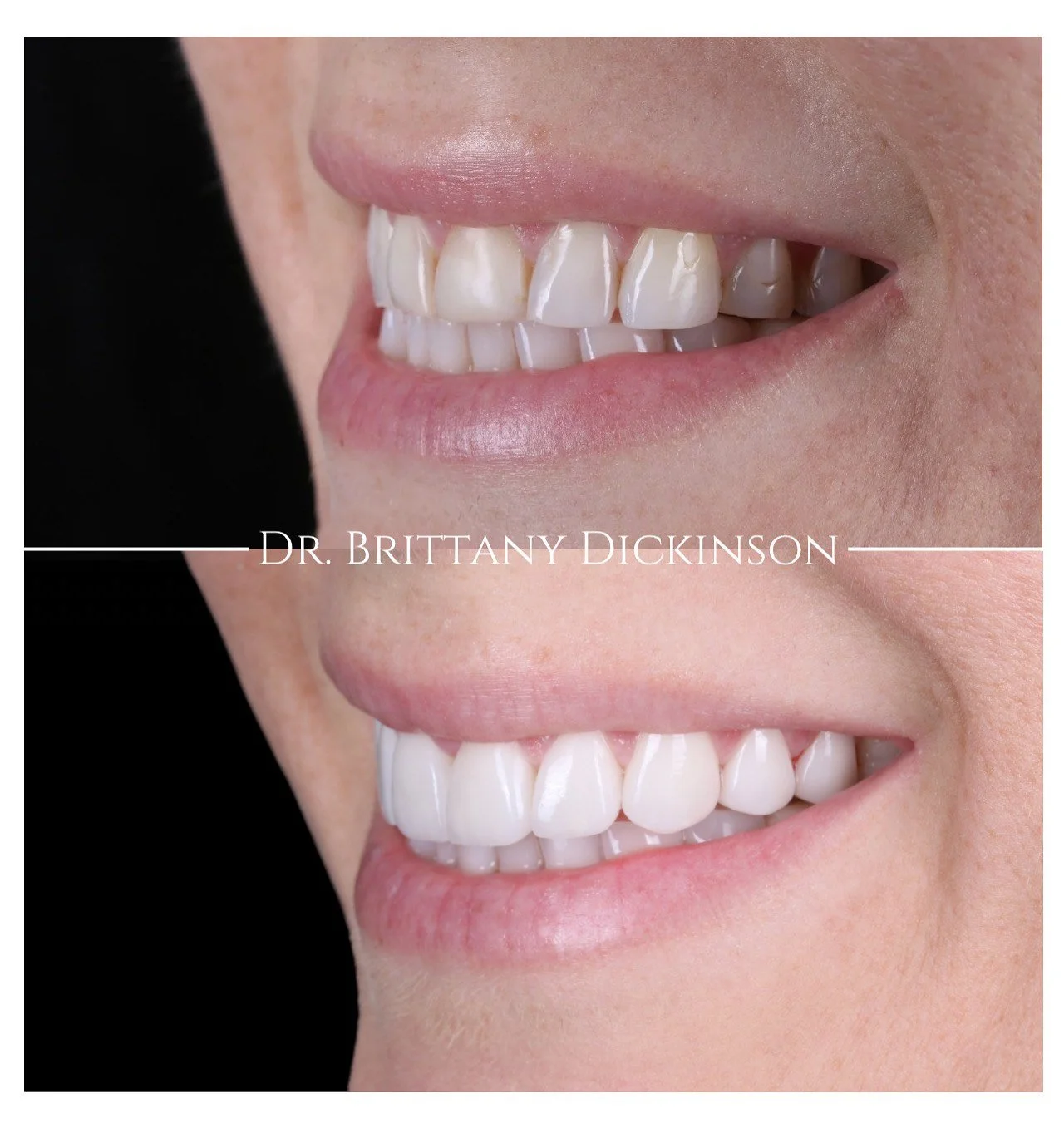
What Cosmetic Bonding Actually Is
Cosmetic bonding — also called composite bonding, dental bonding, or just "bonding" — is a tooth-colored resin your dentist applies directly to your tooth, shapes by hand, and hardens with a curing light. When it's done well, it looks exactly like the rest of your tooth. Nobody, including you after a week, can tell where your natural tooth ends and the bonded portion begins.
For a chipped front tooth, this is the fix I reach for first the vast majority of the time. Here's why.
Why Bonding Is Usually the Right Fix for a Chipped Front Tooth
It's same-day. You called this morning; you can walk out with the chip gone this afternoon. No temporaries. No waiting on a lab.
It doesn't touch your healthy tooth. For a chip that hasn't exposed the underlying dentin or nerve, I bond directly to the enamel around the chip. No drilling. No prep. Your natural tooth stays completely intact underneath.
It usually doesn't require anesthetic. Because there's no drilling for a simple chip repair, most patients don't need to be numbed. You come in, we work, you leave, and you can eat a normal dinner two hours later.
It's affordable relative to the alternatives. In Chicago, a single-tooth composite bonding repair typically runs $500 to $1000 depending on complexity. Compare that to a $2,200–$3,000 porcelain veneer or a $1,900+ crown, and for a small chip, bonding is often the right investment.
It's reversible. If down the road you ever decide you'd like porcelain veneers for your whole smile, bonded teeth can be adjusted or replaced without any damage to your natural tooth. You've kept your options open.
What Bonding a Chipped Front Tooth Actually Feels Like
If you've never had bonding done before, here's what to expect in the chair:
We check the chip. I look at how deep it goes, whether the underlying dentin is exposed, whether the nerve is close to the surface, and whether the chip is stable or still cracking.
We match the shade. Front teeth aren't one color — they're translucent at the edge, warmer near the gum, sometimes with tiny variations across the surface. I lay several shades of composite next to your tooth in the light we're going to use to match, and we pick one together.
We prep the surface. A very mild etch (a gel that roughens the surface at a microscopic level) and a bonding agent — nothing you feel.
We sculpt the resin. This is the craft. I apply composite in layers, shape it with hand instruments, and check it against the shape and proportion of the tooth next to it. For a front-tooth chip, I usually spend more time on the sculpting than on any other step.
We cure it. A blue light hardens the resin.
We polish it. Multiple polishing stages give the surface the same subtle sheen as natural enamel — not glossy plastic, not matte, but real-tooth luster.
Total time for a single-tooth chip: usually 60 to 90 minutes.
You leave with your smile back. No stitches, no swelling, no numb lip through dinner.
How Long Bonding Lasts on a Front Tooth
The honest range is 2 to 5 years for well-done cosmetic bonding on a front tooth in an adult patient with normal habits.
Some patients get 10+ years out of bonding. Others need a touch-up sooner. What affects longevity:
Grinding. If you clench or grind at night, bonded edges are the first place resin chips again. Everyone who invests in cosmetic dentistry — bonding, veneers, or both — should wear a nightguard. This isn't optional; it's how you protect the work.
Habits. Biting fingernails, opening packages with your teeth, chewing ice — bonding will chip before natural enamel does. Break the habit, and the bonding lasts.
Diet. Coffee, red wine, matcha, curry, blueberries — composite absorbs pigment more than porcelain. Doesn't mean you have to give any of it up; a professional polish once a year keeps bonding looking fresh.
The dentist who did it. A rushed, single-shade, unpolished bonding job will chip and stain far faster than a layered, properly polished one. Craft matters.
When Cosmetic Bonding Isn't the Right Fix
I'd rather tell you the truth up front than have you sit through an unnecessary consult:
The chip is deep enough to expose dentin or nerve. If the nerve is involved, you may need more than a cosmetic repair — sometimes a crown or, rarely, a root canal followed by a crown. We'll see this on the exam.
The tooth is heavily worn overall, not just chipped. If your front teeth have lost significant length or shape from years of grinding, bonding one edge will look bulky next to shortened neighbors. In these cases, veneers that address the whole smile are the honest answer.
You want to redesign more than one or two teeth. Bonding is beautiful for spot repairs. For full smile redesigns — changing shape, length, proportion, and shade across 6–10 teeth — porcelain veneers give you more control and last longer.
You've had multiple bondings on the same tooth that keep chipping. At some point, layers of composite become the weak link. Porcelain is more predictable.
You grind heavily and won't wear a nightguard. Bonding on a grinder without a guard is a service call waiting to happen. If you're not ready to protect the work, we should have that conversation first.
The First Question I Ask Every Chipped-Tooth Patient
Before I pick up any instrument, I ask this: "Is this a one-tooth problem to you, or has it made you rethink your whole smile?"
If it's a one-tooth problem — you loved your smile before this chip, and you want it back — bonding is almost certainly your answer.
If the chip made you notice five other things you've been quietly self-conscious about for years — a slightly rotated tooth, a gum line you don't love, teeth that feel a shade too yellow — then this isn't really a bonding conversation anymore. It's a smile design conversation, and we should have it as one.
Both answers are legitimate. You just deserve to know which conversation you're actually in.
What to Do Right Now If You Chipped a Front Tooth
Save any piece you can find. Sometimes we can bond it back on if the fracture is clean and the piece is intact. It's not always possible, but it's worth trying.
Rinse gently with warm water. Don't scrub the area.
Don't chew on that side until you've been seen — a chipped edge can propagate if you keep loading it.
Call your cosmetic dentist that day. For a front tooth, this is a same-day or next-day appointment in most Chicago practices, including mine.
Skip the drugstore repair kit. They exist. They also make the eventual proper repair harder and can trap bacteria against the tooth.
Ready to Fix a Chipped Front Tooth in Chicago?
If you've chipped a front tooth — or if you've been living with a small chip for years and finally want it fixed — cosmetic bonding is almost always where we start. It's the least invasive, most conservative, most enamel-preserving option in cosmetic dentistry, and in the right hands it's genuinely invisible.
Call Chicago Aesthetic Dentistry at773-883-1818 or book online. We're at 3346 N. Paulina St. in Lakeview, and we see chipped-tooth appointments Monday through Thursday, often same-day when the schedule allows.
You don't have to hide the tooth. You don't have to wait to smile in photos this weekend. Come in and we'll take care of it.
— Dr. Brittany Dickinson, Chicago Aesthetic Dentistry