

Can You Do Invisalign If You Already Have Veneers, Crowns, or Bonding? What Cosmetic Patients Need to Know
I hear a version of this question almost weekly:
"I already have veneers on my front teeth. My lower teeth have shifted. Am I stuck? Or can I still do Invisalign?"
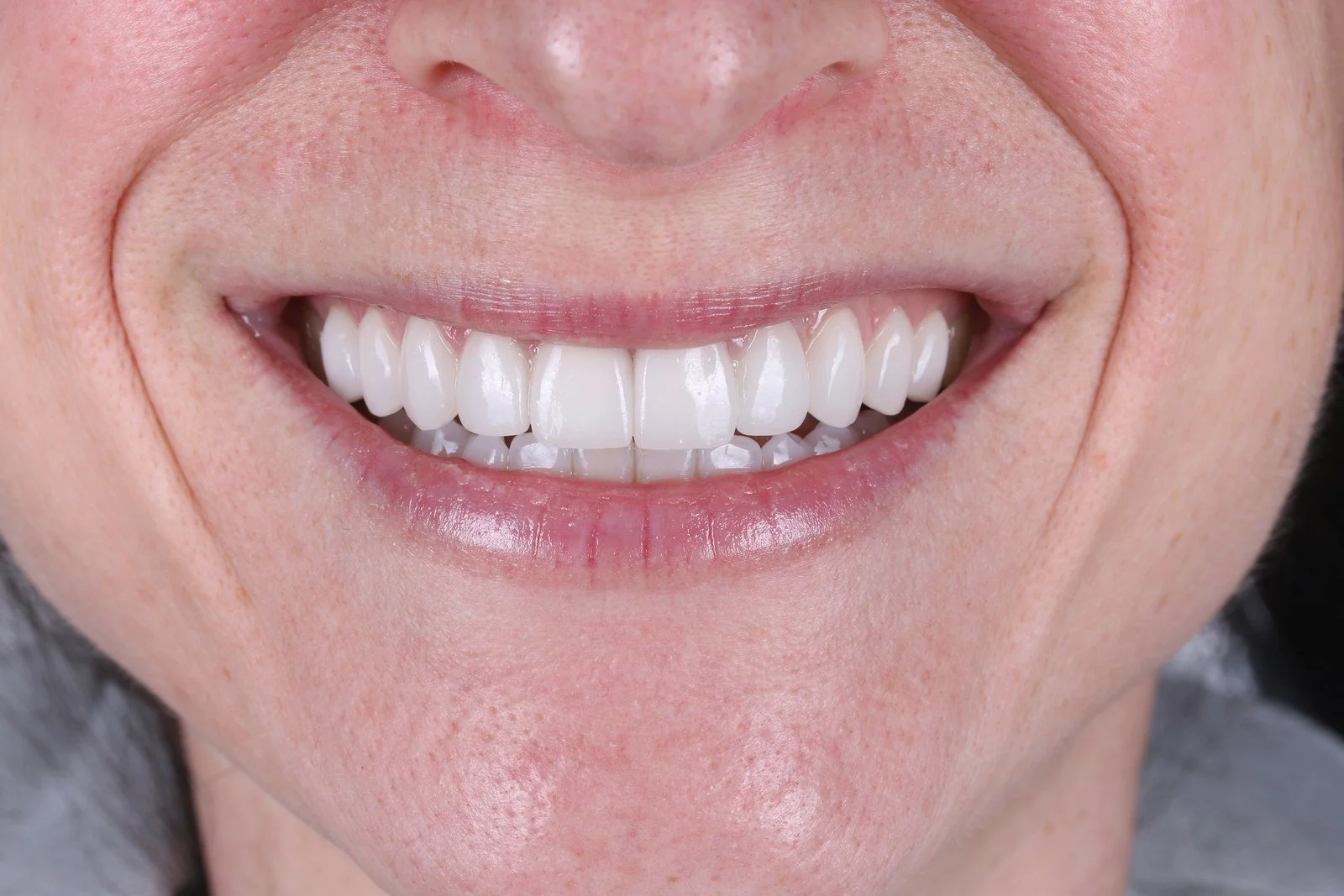
Sometimes it's veneers. Sometimes it's a couple of crowns from a long-ago root canal. Sometimes it's composite bonding from a chip in their twenties. The specifics vary. The anxiety underneath is the same:
"Did the work I already did disqualify me from the treatment I want now?"
The short answer is: almost never. But it does change how a good cosmetic dentist plans the case. Let me walk you through what actually matters.
Yes, You Can Almost Always Do Invisalign With Existing Dental Work
Existing crowns, veneers, and bonded teeth can be moved with Invisalign the same way natural teeth can. The tray fits over the whole tooth — porcelain or enamel — and applies gentle, controlled pressure. Your existing restorations don't have to be removed to start treatment.
Where it gets nuanced is with attachments, the small tooth-colored bumps we bond onto teeth to help Invisalign grip and rotate them more precisely. Some restorative materials (especially older ceramics and certain zirconia crowns) don't hold attachments as reliably as natural enamel or newer porcelain veneers. A cosmetic dentist planning your case needs to know which of your teeth are restored, with what material, and how old — and design the attachment placement around it.
This is exactly the kind of detail that gets missed when a treatment plan is auto-generated by software without a clinician's eyes on it.
What Changes When You Have Veneers or Crowns
Three things a thoughtful provider will consider before starting Invisalign on a patient with existing cosmetic work:
1. Where the attachments go. We may need to skip attachments on certain restored teeth and add them to adjacent natural teeth to compensate. This is a solvable problem — but it's a planning problem, not an afterthought.
2. How the movement affects the restoration. Every crown, veneer, and bonded tooth was designed for the position it's currently in. When we move that tooth, the way it contacts the teeth above and below it will shift slightly. Sometimes this is fine. Sometimes we plan to adjust or replace a restoration at the end of Invisalign — for example, if a slightly misaligned crown ends up in a new, better position where the shape no longer looks right for the smile as a whole.
3. Whether the existing work is aging. If a patient has 12-year-old veneers coming toward the end of their lifespan (typical range is 10–15 years), it's often smart to sequence Invisalign first, then replace the veneers at the end — so the new veneers are designed for the aligned position, not the old one. That's cheaper long-term and looks better on the face.
What About Bonding? Does That Change Anything?
Composite bonding is generally the most forgiving of existing restorations when it comes to Invisalign. Bonding sits on the natural tooth surface and can usually accept attachments the same way enamel can.
That said, older bonding sometimes shows staining, chipping, or margin discoloration by the time a patient is ready for Invisalign. This is often a good moment to plan a small refresh — either replacing the bonding at the end of Invisalign, or upgrading to porcelain veneers if the smile design calls for it. We can walk that conversation through at your consultation.
A Real Case: Invisalign After Veneers
One of my patients came in for a consultation with six upper veneers she'd had done nine years ago at a different practice. She loved them at the time and still liked how they looked — but her lower teeth had gradually crowded and were starting to bother her every time she saw a photo of herself.
Her hesitation was exactly what I hear all the time: "I can't do Invisalign now, right? Because of the veneers?"
She could. And she did.
We planned Comprehensive Invisalign focused on her lower arch, with light refinement to her upper arch to relieve the crowding behind the veneers (which we could still move, because the teeth under those veneers are natural). Attachments went on natural teeth on the lower arch and skipped the veneered uppers where they wouldn't bond reliably. Eleven months later, the lower crowding was resolved, the uppers were subtly refined, and her existing veneers still fit beautifully in the new position.
Her only regret, in her words: "I wish I'd asked ten years ago instead of assuming I couldn't."
When You Should Wait, Delay, or Rethink
There are a few scenarios where I might counsel a patient to hold off on Invisalign or rethink the sequence:
Failing restorations. If a crown or veneer is cracked, has recurrent decay under it, or is at the end of its lifespan, we usually address that before or as part of the Invisalign plan.
Active gum disease. Teeth don't move safely through unhealthy tissue. We need to stabilize the gums first.
Unrealistic expectations about what Invisalign can do to restored teeth. Invisalign moves the tooth — it doesn't change the shape, shade, or size of an existing veneer or crown. If you want a new look on your restored teeth, that's a restorative plan, not an alignment plan. Sometimes both are the right answer, in sequence.
None of these are "no." They're just "yes, and here's how we sequence it."
The Facially Driven Angle
At Chicago Aesthetic Dentistry, I plan every Invisalign case in relation to the patient's face — not just the arch. That matters even more when there's existing cosmetic work in the picture, because the goal isn't to move teeth to a textbook ideal. It's to move them to the position where your face looks right, your lip supports properly, and your existing restorations complement the new alignment.
That's the Facially Driven Smile Design philosophy applied to Invisalign — and it's the reason I do every ClinCheck personally, especially for patients with existing dental work. Software can't see your face or distinguish between tooth structure and dental materials. I can.
Ready to Find Out What's Possible for Your Smile?
If you've been assuming your existing veneers, crowns, or bonding disqualify you from Invisalign — please, come in for a consultation before you write it off. In most cases, we can build a plan that works around your existing work, protects it, and gets you the smile you actually want.
You can book a Smile Design Consultation online or call our Lakeview office at 773-883-1818. We're open Monday through Thursday, and we'll find a time that fits your schedule.