

Most of the patients who sit down in my consultation room don't want "a smile makeover." They want to stop thinking about their teeth.
They want to stop angling away from the group photo at the work dinner. They want to stop closing their mouth in the LinkedIn headshot. They want to stop running their tongue over the chipped edge during back-to-back meetings. They want their smile to match the rest of how they present — polished, composed, considered.
What they don't want is for anyone to notice.
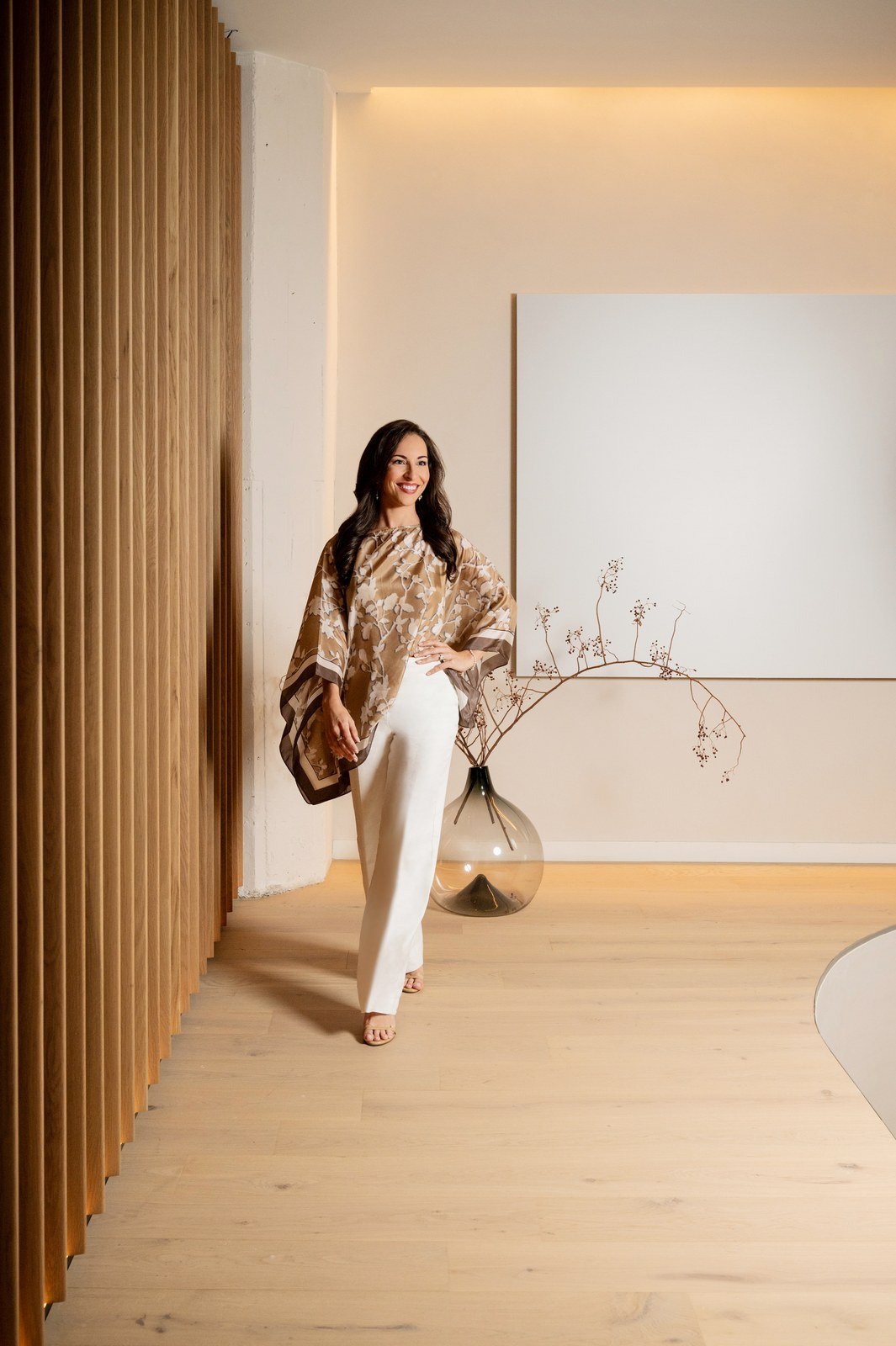
I'm Dr. Brittany Dickinson, a cosmetic dentist in Lakeview, Chicago. I work with a lot of professional women in their 30s, 40s, and 50s — executives, founders, physicians, attorneys, educators — and this is the ask I hear more than any other: "I want my smile to look better, but I don't want it to look done."
This is a natural smile makeover. And it's a specific kind of work. Here's how it's designed.
What "natural" actually means
In cosmetic dentistry, "natural-looking" has become a marketing buzzword — almost every practice claims it. But very few practices actually design for it. Most veneer and smile-makeover work I see — not in my chair, but out in the world — is designed around a template: a specific shade of white, a specific tooth shape, a specific proportion. The result is a smile that looks like a smile from a catalog. Technically flawless. Recognizably not yours.
A natural smile makeover does the opposite. It designs around you. Your face shape, your lip line, your skin tone, your age, how you actually speak and smile. The goal is a smile that looks like your teeth on the best day you've ever had them — not someone else's teeth in your mouth.
Three things make this possible.
1. Shade selection that respects your actual face
Over-white veneers are the single biggest giveaway that someone has had work done. The whitest shade on the shade guide reads beautifully in a before-and-after photo under studio lights. In person, in a conference room, on a video call — it reads fake.
A natural smile makeover uses a shade that works with your skin tone, your eye color, and your age. For most adults, that's a warm, bright shade that's a few steps less bright than the "Hollywood" default. It looks healthy and fresh. It doesn't look bleached.
I usually tell patients: "You want people to say you look rested, not whitened."
2. Shape and translucency that mimic real enamel
Real tooth enamel is translucent at the edges. Light passes through the biting edge, catches, refracts. That subtle optical quality is what makes a tooth look alive instead of carved. Low-quality veneers and bonding often look flat because they skip this — they're opaque all the way through.
A natural smile makeover uses porcelain that mimics enamel's translucency, shaped to match the slight variations that make real teeth look real. Not a row of identical rectangles — a row of individual teeth, each one designed to belong in your mouth.
Up close, you can tell the difference. Which is the whole point.
3. Proportion designed around your face, not a template
This is the part most patients don't realize is even a choice. The proportion of your front teeth — how wide they are relative to their length, how they relate to your lip line when you smile, how they sit against your cheekbones and jawline — is what makes a smile look balanced or slightly off.
The approach I use is called Facially Driven Smile Design. Instead of designing the smile based on textbook ideals or software defaults, I design it in relation to your actual face: your jaw, your lips, your proportions. Then I position the teeth to look right for you — which often means slightly different proportions than the "ideal" would suggest. It's the reason my patients' makeovers look like theirs and nobody else's.
It's also the reason colleagues walk up the next week and say, "Did you change something? You look great. New haircut?"
What a natural smile makeover plan usually involves
For most professional patients I work with, a natural smile makeover is a restrained plan — not an aggressive one. It's usually some version of:
Step 1: Reposition,. If your teeth have shifted since childhood braces, Invisalign first — so the final smile is built on a foundation that's already in the right place. This step reduces how many veneers you actually need, and it reduces how much natural tooth structure we have to touch for the veneers you do get.
Step 2: A small, deliberate number of veneers. Most of my natural-look patients get 4 to 8 porcelain veneers, not a full upper arch of 10. Only the teeth that show in your real smile. The rest stay yours.
Step 3: Whitening to bring untouched teeth into harmony. Rather than matching your new veneers to your existing teeth, we often bring your existing teeth up to the shade we designed your veneers for. A Zoom Whitening Pen ($50) or a professional KöR protocol (starting at $1,100) handles this step gently.
Step 4: A night guard — always. All of my veneer patients wear a custom night guard to protect the new porcelain from grinding and clenching while they sleep. It's included in the plan. It's non-negotiable. It's the reason porcelain veneers can last 10 to 15 years, and often longer, in the real world.
What a natural smile makeover does not involve
Over-aggressive tooth preparation that removes enamel you can't grow back
Veneers on every tooth in your mouth "for symmetry" (your back teeth are not part of your smile)
A "Hollywood white" shade that looks striking in photos and strange in person
A smile designed by a lab tech or software, with no human artistry in the final shape
Anyone other than me, your dentist, doing the actual veneer placement
If any of those show up in a consultation somewhere, that's a signal to pause.
A real case: a Chicago professional who wanted no one to notice
A patient came to me earlier this year — a senior leader at a Loop-based firm, mid-40s, image-conscious in the quiet way that successful professional women often are. Her ask was specific: "I don't want my team or my clients to know I had anything done. I just want to stop thinking about my smile in meetings."
Her plan was deliberately small. Invisalign Express ($5,500) to reposition the mild crowding that had crept back since her teenage orthodontics, then four porcelain veneers on her upper front teeth — shaped to match her face, shaded one step brighter than her real enamel (not bleached-white), with subtle translucency at the edges. A custom night guard and a Zoom Whitening Pen rounded out the plan. About eight months end to end.
Six weeks after her final reveal, she emailed me: three of her colleagues had asked if she'd been on vacation. Nobody mentioned her teeth.
That's a natural smile makeover done well.
How to find a cosmetic dentist who actually designs for natural
A few questions worth asking at any cosmetic consultation in Chicago:
Will you preview my smile before I commit to anything permanent? (The answer should be yes.)
Do you design around my face, or around a template? (Listen for specifics about facial proportion, lip line, skin tone — not just "we use the best materials.")
Will you be the one placing my veneers, or someone else on the team? (It should be the dentist who designed the smile. Every time.)
What's your philosophy on tooth preparation? (Conservative, enamel-preserving answers are a strong signal.)
Can I see your own before-and-afters — not stock photos — of patients whose outcomes look understated, not dramatic? (The "quiet" before-and-afters are harder to find, which tells you something about who actually does this work.)
When you're ready
If a natural, undetectable smile makeover is the version you've been quietly imagining — the one where your colleagues notice you look great but can't say exactly why — that's the version I design.
Book a Smile Design Consultation at the Lakeview office. We'll talk about what you actually want, preview what your smile could look like, and map a plan that respects your face, your lifestyle, and the smile you want to be living with in ten years.
Monday through Thursday. 773-883-1818.